Extract from The Magpie and the Broken Forge
By Stella Eunseo Lee
Long ago when tigers used to smoke, lore and myth became shrouded in secret stories, whispered in candlelight and shadowed behind paper screens. Only the curious and bold would venture to know the truth. The lost remained in isolation, with shame as their only companion. Because it was a world as wild as it was wondrous. And in that wildness, it was often cruel. So cruel that much of the place was broken, cracked and scattered like the ruined earthen works of a tortured potter, untold stories hiding in the crevasses. These stories called upon a certain scholarly magpie who, aside from collecting sequestered tales, was seeking to repair a broken but beloved pipe.
The journey had been long and arduous. The Magpie was no albatross. Flying over the ocean nearly sent the small scholar to a watery reunion with that black-robed ferryman of the dead. He arrived on land with a frumpiness to his feathers. Exhaustion dulled the glossy sheen of green and blue plumage accenting his flight feathers, and his beloved gat was misshapen, held to his head by a frayed red thread.
In another era on a different day, he would have fretted over his frazzled appearance. This was no way to enter a kingdom’s city. But there came a point in life, even in the most proper of scholars, where one has no wherewithal to care and would easily forgo such dignity for a divine cup of tea and a plate of comfort food.
It was through this no-nonsense sense of stubborn will and the help of a generous elderly whale, that he made it to the kingdom’s city port.
From the sky, flying from the river’s port to the king’s palace, he’d seen wealth coursing through the rivers and roads like blood flowing from the veins to the heart. The markets were a colorful marvel. Merchant stalls lively under the cover of dyed cloth stretching across the rooftops, making patchworks of shade in colours rivaling flower fields. Like the flaring skirts of dancing kisaeng, they coyly hid the hustle and bustle of merchants displaying the newest shipments of goods.
He had swooped low to take in the fragrant smells from afar, of honey-cured meat, roasting tea leaves, oils, herbs, and fermented fruits and vegetables. It was a place of abundance, paving a colorful path all the way towards the palace.
And there, on each curved rooftop of the royal grounds, resting from the sharp corners of the shale shingles to the skyward peak at the center, were dragons forged from solid gold. Their long, polished bodies traced the angles of the roofs, facing outward with maws wide open as if to roar high praise of the king’s splendor.
It was divine. It was blessed. It was a load of splattered eagle scat. A honeyed lie, a thieving hive of hornets made fat and arrogant through pillaging the hardworking bees.
There was no denying that the Magpie wasn’t the fondest of cities, though he had a metropolitan indulgence for their teas, biscuits, and quality paper and ink. But he had a particular distaste for this one—and it wasn’t because some noblemen had rudely shooed him away with their fans as though he were some hedge pigeon (as if it were a crime for a traveling scholar to look ragged well-traveled). No, it was because this place was too preoccupied with itself. So much so, it forgot its own people.
We dwell among the common folk.
Those who lived life with an end.
Those who must heed the beckoning of death’s ferrymen.
Those could only fathom our wonders through dreams.
Our wonders that tore their reality at the seams.
Two court appointed officials spoke, strolling through a palace garden.
“I wonder if our king will host another celebration soon.”
“Many moons have passed since we won the war. Surely, he would tire of his flaunt.”
They whispered, knowing that such talks questioning their king would wind up with imprisonment. And not knowing an eavesdropping Magpie hid within the bramble beside them. It wasn’t the most ideal place to eat his foraged mulberries, but it was better than dealing with the unruly palace dog and the even unrulier nobility who thought it proper to chase him away, fearing he’d relieve his bowels on the gold dragons (simply, presumptuously rude!).
The disdainful Magpie nearly choked on his mulberry.
The kingdom was victorious, and to the victor goes the spoils so they say. But when the Magpie flew over the outskirts, over the lands and people the king still proclaimed as his, he knew the truth. The palace prospered, along with its neighboring settlements. But take in a bird’s eye view of the outer region of quiet villages and tilled earth nestled between valleys, and one would only see a land of broken stone and splintered wood.
Mortal rulers often forgot the cost of forging blades over plows. Like brutish little demigods teething on the delicate world, forgetting it could bleed.
The twisted irony of it all. This city was considered to be a glorious place. Built beside a river lovingly curled against a king’s mountain, supposedly blessed by Haemosu when he came upon the place whilst riding his six dragon chariot. They said the sun god had been so enamored, he gifted the land with earthen sunlight. And yet, with all that gold, the kingdom’s centralised splendor only stretched its shadows further.
They knew me not by name nor face. They knew me by my creations
By the sound of my hammer,
of metal against metal,
of wood growling and groaning at my demand,
of the crackling, popping and hissing of my fire.
Either yearning for my gifts or fearing of my ire.
Perhaps this was my name for a time. The sounds that came from my forge.
For what is a name but an amalgamation of sounds molded by tongue and teeth?
Tongues of flame. Charred, jagged teeth of coal.
Not that it matters any longer.
For now, they know me by different sounds. Because of the things I created.
When the Magpie arrived at the edge of the kingdom, his shabby appearance felt refined here. Wrath and ruin burned away the thatched roofs. Horses and soldiers had trampled the fields.
When the fray had come upon their humble gate of stone and wood, the villagers had fled to the mountain’s embrace. It was with great irony that the wilderness did more to protect them than the king’s warrior did, but that protection came at the price of their homes.
The market was a graveyard of broken crates and splintered stalls. The rain from the merciful dragons had cleansed the walls and roads of the violent stains, but it could do little to wash away the deep wounds inflicted on this place and its people. As of now the wound was still too fresh to be called a scar, too tender to be forgotten with laughter and hard work. It was a part of them still. The keen bird could see it in the darting eyes of hollowcheeked children. They kept themselves scarce. A loud sound or a sharp glance sent them skittering away.
If one saw the state of this village, cast in the shadow of the colourful city, they would not believe the kingdom had won. But that was often the case with war. It always made the lesser of status suffer the consequences of the greater.
Yet, not everything was left to rot and crumble. The Magpie did not fly all the way here, beneath the scrutiny of the moon, through blistering winds, and over thrashing seas, to record the suffering of this place. No, the scholar came here because there was hope in the wreckage. One that could return something precious to the magpie.
In the Magpie’s satchel, tucked away amongst the bottled ink, quill, and papers, there was a pouch. Within the pouch was a pipe made of lacquered wood with polished copper as both bowl and mouthpiece, broken into pieces after a little mishap with a little tiger. The pipe was as important as the thimble-sized gat tethered to his head. The Magpie would not forgo it for another, despite the insistence of some venders and makers. No artisan near the palace could repair the pipe—either that, or they did not want to. Feathers ruffled and feet sore from flying and landing over and over, the Magpie was about to give up for the day when a shaman came across his perch on low hanging branch of a persimmon tree.
“Seek the old smithy beside the blue mountain. The one where the forge burns blue. There’s someone there that will help you.” She said.
That someone was an old artisan known to make broken things whole. They had a shop at the end of the forgotten market, a soot stained workshop and smithy around the corner, shyly tucked by the base of the mountain. The elders of the village regarded the artisan highly, explaining to the Magpie that he came after the war when the town had nothing to offer. He kept to himself, quietly accepting requests to forge new farm tools or mend beloved ones. But when the Magpie arrived, the shop was empty. So empty, it appeared abandoned. He was about to pluck his feathers in disappointment, but before he could stew in any frustration, commotion beckoned his attention.
“Just throw it away and purchase another!” It was an old man, wobbling on a cane, gnashing more gum than teeth. The man pointed a gnarled finger at a woman cloaked in white. From the hem of her bellflower skirt to the knotted charm hanging from her waist. The long jang-ot coat covering her head was made of rich pale green fabric embroidered with delicate yellow flowers.
Her opulence did not belong here. Even with his poor eyesight, the old man knew it, too.
“I know you can.” He spat, stomping his cane, “You smell of silk and honey. Don’t trouble us with such foolish requests and go commission a bowl from a palace artisan. Even better, get a vase or a tea set.”
“I refuse.” The woman’s voice was soft, too soft to make such demands and yet it persisted, “It must be this bowl. Please, I beg of you, tell me where the master is.”
The elder refused and turned away. She reached for him then, with urgency hastening her slender hand. The motion startled the senior. He shook away her grasp and his cane knocked her package out of her arms. It unraveled as it fell, revealing a small pile of broken ceramic. The pieces bounced and scattered on the thatch road. Without a moment’s hesitation, the maiden knelt to the ground and began picking the pieces as the old man left in a huff.
As she knelt, she flared out the front of her pale skirt, creating a makeshift basket, and as she did so, the Magpie swore he saw something golden glint just beneath her cloak.
Curiosity beckoned the Magpie forward for a closer inspection, a motion mirrored by another.
“This backwater village is no place for a princess.”
The stranger came with the quiet wind. How and when he exactly arrived was unclear and baffled the keen eyed bird. He had the face of a noble— clean, fair and angled high, with clothes to match the status. The pastel blue robes of his sleeveless jeogori were pristine, draped over his white hanbok, complimented by an ivory sash and a finely tailored baji. The trousers were hemmed just at the end of his ankle to a pair of low cut shoes the Magpies recognized as hye, made of leather rather than hemp and only available to the nobility who could afford the craftsmanship of a gifted cobbler. He had in his hands a fan, paper folds flared, revealing a painting of a pale bundle of flowers sprouting from heart-shaped leaves. The fan was bound together by bamboo blades bolted to a braided cord.
There was something odd about this nobleman. His jeogori was too clean, following the current of wind that swept the long billowing sleeves of his hanbok until they swayed altogether like the tasseled branches of a spirit tree. Even the silk chinstrap securing the gat atop his head held a sheen.
Beside the young lady cloaked in many colours, the Magpie has never seen two creatures more sorely out of place.
Strange strangers they were. A nobleman and a princess, and indeed she had to be a princess to be allowed gold on her person. But such company in these poor parts either brought troubles or a mystery. The Magpie hoped it was the former and not the latter. The land here had suffered enough troubles.
The nobleman stood tall before the young lady, causing her to lift her head to give him a good look, nearly exposing her face. Under the hood, gold began to shimmer and wink. It tempted the Magpie’s curiosity, urging him to hop off his persimmon branch for a better look. But experience told him to resist. Only a fool discarded caution for temptation.
The maiden held out her chin in a show of defiance, almost petulantly. And as she did, the amber glow of glinting gold danced, tracing her jaws.
“This princess will do as she pleases.”
The Nobleman tilted his head and folded his fan with a rustling snap. His face was handsome by the standards of the human folk and curved into a mischievous smile.
“Because of your divine right?” The Nobleman asked.
The Princess responded with a curt nod, earning a chuckle.
“A right to peril, I think,” the Nobleman remarked, eying the surrounding area. His gaze hardened when sweeping through the dark alleys where the greedy and desperate lied waiting for an ample opportunity.
“And some foolishness.” He pointed his fan admonishingly at the girl. “This is no longer a place fit for a princess to wander. You stand out like a bright candle, your highness.”
The Magpie could no longer hold his scoff.
“Both of you are ill suited for this land.” He preened his flight feathers, never taking an eye off the pair. They looked up at him, the princess startled while the Nobleman remained jovial and calm. His smile dimpled at the sight of the scholarly Magpie as though he spotted an old acquaintance. The Magpie returned the smile with a suspicious glare.
“You walk around and talk of peril, but where is your weapon?” The wary bird asked.
There was no weapon on his person, not even a dagger. Perhaps it was hidden, but it would not make sense for a nobleman to conceal every weapon to the point of ridicule. A bird flaunted their most vibrant feathers. A tiger bared their largest teeth. In this kingdom, a man brandished a blade. The brighter, sharper, and more polished the metal, the better.
This yangban human only had a fan. One that he twirled yet another time before securing his gat. Speaking of, the Magpie couldn’t help but be envious of his hat’s condition. There were no frayed bits of horsehair sticking out along the brim. And fine beads even decorated the cord arched beneath the man’s chin.
“How thoughtful is your question,” the Nobleman said, “I expect nothing less, especially thoughtless, from a mindful magpie.”
He lifted his head a bit higher, meeting eyes with the scholar. The man’s eyes were bright and bottomless. Coy and clever, but absent of malice. The Magpie could tell. Animals, especially ones as witty as he knew, these things without rhyme or reason. Such was the magic of this world and their place within it.
And so when the Nobleman beckoned them, the bird was at ease.
“Come, let us seek some shelter in the old forge. I have some buckwheat tea.”
What scholar could resist tea and a tale? The Magpie hesitantly agreed and his agreeableness assured the Princess to follow suit.
The flames were my pride. The iron my blood. The hammer and tongs my will.
There was no question in why I chose the forge.
For we were folks who danced with fire.
There was no question, only wonder.
I created marvels. I created treasures. My forge birthed beauty.
Or so I thought…
Until those treasures, in that misbegotten pride, began to birth their own fire.
Ravenous, endless, unquenchable fire.
And from their iron came rivulets of blood.
The forge bore all the elements, and the elements never forgot. The wood bore scars, the water cherished memories, the earth preserved history, the fire told stories, and metal bore the heaviest burden of carrying legacy.
Droplets from the recent rainfall bounced off of a rusty anvil, collecting into the grooves carved into the stone tablet where it lay. It smelled strange here, coppery, cold, and old. It tickled his beak and ruffled his feathers with strange reminiscence, like old scrolls transcribed with tapestry long tales. Scorch marks traced the walls, painting the table of carven stone. There was little in terms of personal belongings, only a pile of broken tools abandoned in the far corner of the place.
The Princess entered the forge without the usual grimace or scorn that often besmirched the riches’ countenance when entering such a woebegone place. She sat herself on the stone stool, her eyes sad and searching for the artisan they both sought. Her knuckles were white, nearly as white as the skirt they clenched, keeping the shards of the broken pottery tucked safely away. There was still no sign of the artisan. She sighed forlornly, and under the shelter of the abandoned place, she unveiled her jang-ot’s hood, exposing her head for all to see.
She was as comely as a royal should be, but that was not what made the Magpie squawk.
Gold clung to her. Like a tree rooted upon a boulder.
The sun’s setting hues peeked through the window’s splintered bamboo blinds and kissed the gold adorning the princess’s unveiled face. Each plate and chain showered the room in warm stars. The gold hoops and bands with dangling jade on her ears and around her delicate neck seemed to glow brighter, becoming celestial bodies for the glittering light. The Magpie was open-beaked, mesmerized for what sensible corvid was not enthralled by beauty right before their eyes.
“Does your kingly father know you’re here?” The Nobleman asked. If he was as shocked as the Magpie, he did not show it.
The princess ducked her head. Her eyes brimmed with untold sorrows as they stared at the shards resting in her silk skirt.
The pieces of the pottery, itself, didn’t seem all that splendid. In fact, under the radiant gold on the princess, the broken shards appeared dull. It was simple, absent of any etching but held the faintest touch of a pale green celadon glaze. Not the worst piece of pottery he’d seen but certainly nothing worth preserving. And the Magpie had seen some marvelous works. A celadon vase wrapped with a thousand flying cranes, a dragon-shaped pitcher capable of pouring endless wine, a moon jar worthy of a dance under starlight. But this princess held the bundle of plain shards as though they were the finest treasure of her golden halls.
“My lord father does not know, and I would prefer to keep it that way. He would rather have me trapped in a chest than afoot beyond the gates.”
The Nobleman replied gently, “Then you should return to the palace, your highness.”
He was a bit too composed for this situation. From what the Magpie knew of the king, he coveted his treasures. And this gold laden daughter of his was without a doubt, one of his greatest treasures. If they were caught, the king would likely forgo a trial in his ego-wounded fury and immediately order a beheading for the Nobleman—maybe with some torture to make a statement. As for the Magpie, he’d be plunged into a boiling cauldron of soup or even worse… caged and forced to draft up soliloquies praising the king.
The Princess shook her head and held up her bundle of broken shards, “Not until this one is fixed. I know there’s a master around here, somewhere. I know he can make it better.”
Both bird and man peered at the shards.
“Surely,” the Magpie wondered, “one of your royal artisans could mend this….”
“Bowl. It was a bowl. And none of them could. They tried, but the pieces refused to stay together.”
The Nobleman hummed, thoughtful. “Such is the conundrum with magical things.“
“You can sense it, then?” There was hope in her voice.
“Yes, just as I can sense the same is the case for the broken object in your pouch.” The Nobleman gestured casually to the Magpie.
The curious bird gave a trill of surprise, “What do you mean by conundrum?”
The Nobleman perused the old forge. His words were paced with each deliberate step,
“Magic values the ‘why’ not just the ‘how’. Intention is a powerful thing. Exceptionally so in the hands of a master who can cross the boundaries between the finite and the infinite, between mortals and things mortals deem a myth.”
He stopped by the ruins of the smithy’s furnace. It was missing brick in places, resembling a many eyed monster with a gaping maw. The rain hadn’t entirely washed away the soot staining the stone and clay mouth. Lines of black trailed from the orifice of the furnace, resembling drool and tears.
The Nobleman sighed and stroked the black ribbon tethered beneath his chin.
“The master you seek had long abandoned this place. They became a hermit soon after the war’s end and sought solace in a sansin’s embrace.”
The Princess looked puzzled.
“The master is with a mountain spirit?”
Meanwhile the Magpie perched himself near the window and stared out into the distance until he spotted what he sought.
“There is a place not far from here. A place of many caves, once home to a mountain spirit’s shrine.”
The Nobleman nodded, adding, “There is an old path behind this forge. Though I’m afraid it’s a strenuous path, perhaps unfit for—“
“Quickly!” The Princess interrupted, cloaking herself once more, concealing the glory of her gold adornments. “To the mountains!”
My genius was renown.
Even the king with the golden crowd couldn’t resist.
He gnashed his grinning teeth in envy.
I had basked in it. But for every reward, every acknowledgement, every affirmation given, something else followed suit.
It followed like a corpse tied to a chariot.
I saw it on the anguished faces that could not look my way.
I heard it through the mothers weeping for their lost sons.
I smelt it within the cinders falling like winter’s first snow.
The path was narrow and the mountain, broken. Shattered long before the war etched into the memory of the masses, it had been a dueling ground for unyielding gods and a resting place for solitary souls.
Hands clasped behind his back, the Nobleman led them with a strange, lighthearted bounce to his steps. Even as the moon took the stage from the tired sun and as the path of thatch became that of wild, untillled earth, the Nobleman remained unbothered as he led them into the mountain.
It made the Magpie suspicious. For a man with such clean shoes and fine robes, he traversed with such lackadaisical grace. Especially in the presence of royalty, one would think there was a little more decorum.
“You’re a strange nobleman.” The Magpie thought aloud, landing atop a wooden pillar marking the end of the village.
The Nobleman turned to look at the Magpie. His feet danced gracefully around a rock hiding in the tall grass.
“Surely a traveling scholar such as yourself has seen stranger things?”
The scholar ruffled his feathers, “Strange is strange. How does a nobleman know so much about magic?”
“Why, like any educated person, we listen and learn,” The Nobleman then flicked his wrist and flared out his fan. “And I learned much by dancing with shamans.”
“Dancing?” The Princess shared the Magpie’s surprise.
“It’s a marvelous pastime. Though I prefer a good wrestling match, a dance, especially with a mudang well versed and emboldened in their shamanic ways, can often feel just as exhilarating as a good wrestle.” The Nobleman swayed, hopping from one foot to another, matching the undulation of the wind caressing the tall grass.
“Strange, indeed.” The Magpie mused before taking flight.
He flew on ahead, keeping the princess and the noble in sight. No matter how fluid their footsteps were, the bird did not envy their trek. The trail was rough and uneven, having been paved by nothing but a few wandering feet. But, much to his surprise, there was not a single voice of complaint from the princess and she stumbled the most.
Each uneven step should’ve rattled the porcelain pieces as it did with the beads on the nobleman’s hat and the crown hiding under the princess’s hood. But the princess held the broken bowl with such care, close to her heart, bundled in silk and cradled in her lithe arms.
So the Magpie descended, catching some hasty wind to slow his glide until he was in earshot and asked the question that had been constant on his mind,
“Why do you insist on fixing the bowl, Princess?”
The Princess held the shattered pieces closer as she spoke,
“Because the bowl was once a lump of clay, and that clay was my dearest friend.”
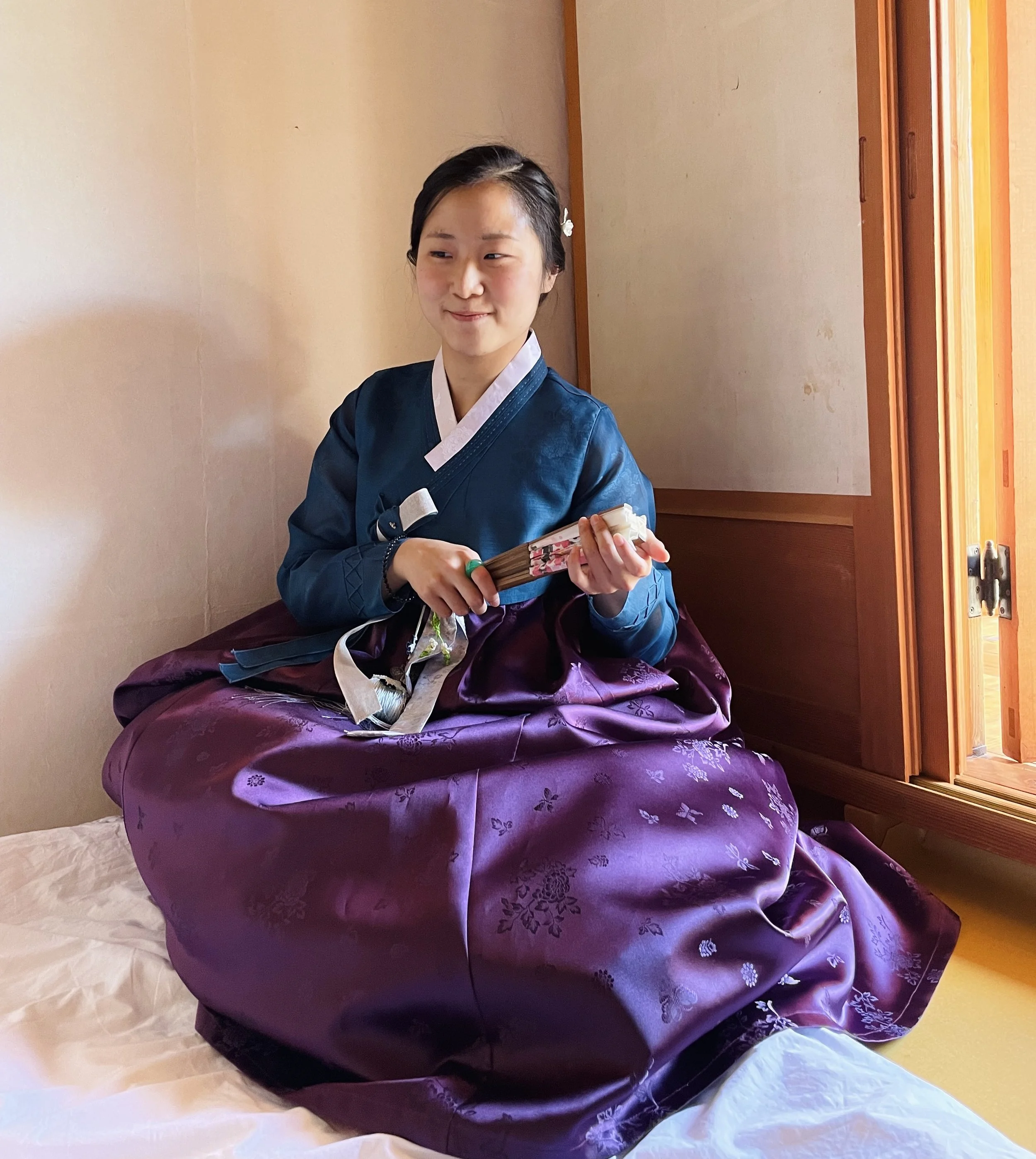
About the author
Stella Eunseo Lee is a creative who finally put her maladaptive daydreaming to great use by becoming a writer. An adventurer with a penchant for wit and proclivity for episodic mishaps, in this piece she combines her love of fantasy with her cultural heritage to craft a thoughtful and whimsical tale inspired by Korean folklore.
It is an excerpt from her series of stories about a scholarly magpie who chronicles and embarks on many adventures in the world of Korean myth and mysticism.
Stories are the deeply rooted anchor in her transient life, her home and hearth as a multicultural immigrant. Be it getting lost on an island off the New Zealand coast or spending 800+ hours on creating the perfect game run on the hardest level, this cat loving tea-enthusiast has a deeply entrenched love and understanding of stories and their significance. Thus, she hopes to write tales that become a home and hearth to readers who need some starry-eyed wonder and respite in their lives.