Extract from The Lost Verses
Nishita Naga
For thousands of years, the world has willed itself to begin again. It has survived through millennia of destruction and rebirth in a self-fulfilling prophecy. I have seen it end once, and I have seen it be reborn. I have heard the world speak its destiny into existence, and I have filled myself with its desires.
There is a great power in the universe my people called Mayyah. It wanders in the threads of our universe searching desperately for its conduit. It grasps at the fabric of the world it has created for something — someone — who can carry our past, present, and future. Powerful Mayyads have existed since before my own birth, but none who could harness Mayyah the way it desires. For one hundred years, I have felt the harbinger of fate coming. With each decade, Mayyah gets stronger. It eagerly awaits her arrival, as it simultaneously molds itself to her impending presence and prepares to bend to her will.
An augury echoes in my head, but I cannot make out the words. The language of my childhood is morphed, warped like sound underwater. It is not time for me yet. I see a child, and her face becomes clearer as the years pass. First, I can only see her life force, pulsing brightly within the threads of Mayyah, already warning the world of her presence. Recently, my awareness grows, and she walks the world, her every step sending rippling effects through Mayyah. Something is coming. This time, Mayyah is not simply preparing its rebirth, but to change unlike it has before in the vast expanse of time. I wonder if the rest of the world can feel it too.
Raisa liked to train without armour. It made her feel more legitimate — like the warriors in her history books who took down hundreds without batting an eye. Her siblings did not have the same preferences. Eyan always trained in full armour with proper form, especially in front of his younger sisters. Trying to set an example, Raisa assumed.
Since they had been children, Iyla preferred shielding her chest and donning cuffs on her arm, avoiding anything heavier while she launched arrows from every type of bow Rahsahri had in its armoury. Raisa had always found the bow and arrow a flawless weapon, but she was unsure whether it was the bow and arrow itself or Iyla wielding it. There was a precise perfection to everything Iyla did. The Rahsahri had a saying that a person’s weapon was a reflection of themselves. Raisa had never understood what that meant until she watched Iyla loose twenty arrows exactly to their marks in under a minute.
Eyan strapped a training shield to his arm and a lightweight cuirass to his chest. His weapon very much resembled their father’s, a decisive, decorated broadsword. Contrary to his unwavering movement, Raisa might have resembled a mongoose battling a lion. Iyla was perched on a flat roof above the training compound, leaning against a longbow and hawkishly gazing at her brother and sister below.
‘Whenever you’re ready,’ Eyan taunted with a knowing grin.
Raisa waited to draw the short swords strapped to her thighs. Her movements mirrored her brother’s, and they circled each other in what could have been a previously planned pattern. Eyan twirled his sword comfortably in his hand, his shoulders relaxed into a practiced offensive stance. Raisa drew and positioned her short swords, taking a guarded defensive pose, but her shoulders were tensed, grazing her earlobes. She tried to loosen her muscles like Eyan’s, but the more she tried to anticipate his next movement, the more quickly her shoulders rose back to her ears.
Eyan shuffled forward, bringing his weapon down on his youngest sister in an arc fit for a giant. The sudden clink of Raisa’s short swords resonated in the otherwise quiet training court. She wove under Eyan’s strike to deflect his blade with both of her own. Raisa moved quickly, driving the hilt of her right weapon into the underside of Eyan’s arm and swivelling to face his back. She did not strike again. Rahsahri warriors always struck their opponent from the front.
‘Ow.’ Eyan shook his arm but did not drop his weapon. An intricately carved gold dragon glinted along the length of his blade, the symbol of Rahsahri. Their training tunics fluttered in a welcome breeze from the savannah. This time, Raisa lunged, darting from side to side, her swords in continuous motion. Eyan’s blade met her swords with a jarring clang in their first two strikes. The third nicked his forearm and he hissed, shoving Raisa backwards with his shield. A bright red cut glistened against his skin.
‘Tired?’ Raisa quipped, and Eyan shook himself as though he were getting rid of dust on his sleeves.
‘Your attacks are getting sharper,’ he observed. This time, he stepped diagonally. Raisa caught the broadsword just above her left shoulder and her blades made an ‘X’ shape, pushing upward against Eyan’s brute force. The hilt of Raisa’s right weapon pressed into Eyan’s arm. She pushed forward with all her weight. In her whole life, Raisa had never been able to knock Eyan off his feet, but a boulderlike force filled her arms and torso, propelling her forcefully against Eyan. He landed with an unceremonious thud. His grand sword fell with him, still secured in his white-knuckled grip. ‘Either something is irritating you today or you have become a stellar fighter,’ Eyan said, releasing his training shield with a sigh. It hit the sandy ground with a gentle thud. Raisa smiled widely, offering her hand to help him up.
‘Eyan, you’re on the ground!’ Iyla called, jumping down from her perch and giggling at her older brother.
‘Yes,’ Eyan said, hoisting himself up. He placed a heavy hand on Raisa’s shoulder. ‘I’ve been bested it seems.’
Iyla reached the middle of the court where Raisa stood and nudged Eyan. The two of them were only in their early twenties, but they looked so much older than Raisa already, she thought. Taller, more skilled. Although perhaps she was finally catching up.
‘That was brilliant,’ Iyla said, beaming at Raisa. ‘Your footwork has gotten very clean.’
Iyla had once made Raisa practice her footwork by launching a volley of arrows from the archer’s roof of the palace’s training compound. Since then, Raisa no longer made accidental steps into her sparring partner’s line of fire. With the precision of Eyan’s strikes, that served her well.
‘Eyan.’ Shaj stepped into the court, followed by Raisa’s second older sister, Vaara. Eyan straightened at the sound of his name, the defeated slouch in his shoulders disappearing. He looked so much like their father, Raisa thought. All her siblings had Shaj’s jet-black curls, but it was more than that. Shaj, and Eyan, fit the mould of Rahsahri’s emeraj effortlessly. Both were stoic, dignified, collected, all tenets of admirable warriors. Their every move was carefully considered well before it was made. When Shaj called his son’s name, his voice resonated throughout the training court. Anyone in earshot could not help but stop what they were doing and listen: ‘The adkhir, Marcellus, has sent word. He requests an official presence in Ftahraj immediately.’
‘For what?’ Raisa asked before Eyan could.
‘He calls it an unidentified threat,’ Shaj read off a small piece of paper. ‘Not very specific. I would go myself, but we’re set to have a visitor from Amnasi either today or tomorrow.’
‘Another “alliance” proposal?’ Iyla asked. She raised her eyes to Vaara, who stood silently behind their father. Since she had turned nineteen, Vaara had been entertaining a slew of marriage proposals at their mother’s behest. Raisa had always assumed Iyla would be doing so as the eldest daughter, but she spent as much time with Raisa and Eyan in the training compound as Vaara spent discussing political alliances with their parents.
Vaara nodded. ‘I think this one seems reasonable,’ she offered a contemplative endorsement. ‘Amnasi has all the resources available to it as a sovereign city. It sounds to me like quite the opportunity. An alliance between the city most skilled at war and the one most skilled at peace.’
‘Vaara.’ Raisa scratched her head. ‘Not to be rude, but you don’t spend any time training in combat or strategy.’
It was true, Vaara had never seemed as interested in the typical Rahsahri education. How was she imagining representing a city of warriors without a warrior’s education?
‘We would have their loyalty and access as they would have ours. Besides, I’m not completely useless,’ Vaara rebutted.
Raisa contorted her face and opened her mouth to retort quickly, but Iyla spoke before she could, ‘No one said that.’ Iyla rolled her eyes.
Eyan cut their conversation short. ‘I will start riding to Ftahraj at once,’ he announced.
‘Let me come too.’ Raisa nudged him forcefully. ‘After today you definitely cannot make the claim that I am unable to hold my own.’
Raisa knew this was an exaggeration. Both Eyan and Shaj had taken her on a number of diplomatic excursions to Rahsahri’s borders and in Hridadhir, but this felt important. The air around her whispered an urge to join this mission that she could not understand.
‘What’s all this about?’ he asked, eyebrow raised in a gentle demand to Eyan.
‘Raisa had Eyan flat on the ground today!’ Iyla announced before Eyan could explain.
‘Impressive,’ Shaj said with a proud smile in Raisa’s direction.
‘Whatever.’ Sourness seeped into Eyan’s voice. ‘I’ll take you,’ he said to Raisa, ‘but you have fifteen minutes to be ready and saddled.’
Raisa nodded and whistled past her father and older siblings. Her flat, curved training sandals made no sound as dust kicked up behind her feet and touched the edge of the marble floor before she entered the Rahsahri palace.
The Rahsahri palace armoury sat at a slightly lower level than the palace itself, the sovereign family’s armour nestled in a small room just beside the formal armoury. Raisa ran her fingers over the jewel-encrusted armour as she passed through the formal armoury. It was highly unrealistic for any sort of combat, but this was Rahsahri ceremonial armour. Every element of each set, including Raisa’s, was passed down from generations of Raisa’s ancestors. She could point out which of the rubies inlaid into her metal gloves came from her great grandmothers’ daggers, or which sapphires were handed down from the second sovereign of Rahsahri. As her mother always said, Rahsahri ancestral armor reminded the rest of Késhtr of a renowned heritage, so these sets were reserved for political discussions and ceremonies.
Inside the family armoury, a carved set of white and gold armour was strapped to a figurine Raisa’s size. She leaped into it, not bothering to change from her cotton training tunic. This armour was far simpler, appropriate for combat. Its metal glimmered in the morning sunlight, creating fantastic shadows as Raisa continued to hurry down the stairs to the stables.
‘Ready?’ Eyan asked, poking his head in as Raisa saddled her horse.
‘Ready.’
Ftahraj was the oasis in the middle of the largest desert in Késhtr, which was aptly named for the largest city surviving in its sands. Despite its unforgiving environment, Ftahraj itself was a haven for warriors of Rahsahri’s province. Descendants of the Rahsahri sovereign family spent their younger years training there before returning to Rahsahri to fight in the armour of their forebearers.
The steady warmth of Rahsahri turned into dry heat as the horses galloped a day’s journey north into the Ftahraji desert. Ftahraj stood steadfastly around sparse greenery and pale blue patches of water—the only sustenance in the largest collection of sand dunes Raisa could imagine. The horses whinnied and yielded as they closed into the sandstone gates.
‘The gates are open,’ Eyan announced with narrowed eyes toward the city entrance. His gold arm cuffs clinked against the horn of his saddle. Raisa listened for the sound of weapons hitting the ground and drills being shouted, but the only roar was one of the arid winds as the town stood in a stoic hush. Raisa and Eyan rode in as discreetly as the dirt road allowed.
Ftahraj stood low, the flat, mud terraces of each building no doubt housing the best archers in Késhtr. They were completely out of sight. Ftahraji warriors surrounded the main square, gathered in acute attention around a mounted figure. A stranger. Raisa swung from her horse to stand in the court. ‘Where’s Marcellus?’ she mouthed to Eyan. As though she had conjured the trainer of the Ftahraji forces himself, Marcellus appeared on the other side of the city square, his dark skin reflecting golden in the light. The stranger’s mount faced Marcellus, but Marcellus’ eyes settled on Eyan.
If Rahsahri warriors were the most skilled in Késhtr, Marcellus was the one to thank. Not only did he train every member of the Rahsahri emeraj’s family, but he oversaw the training of every warrior that came through Ftahraj. Many of the warriors that came through Ftahraj before joining Rahsahri’s official ranks were more skilled than their counterparts that had trained in the city of Rahsahri or elsewhere in the province. Even Eyan had only ever landed a single blow during a training session with Marcellus. He had still lost the fight.
As far as Raisa knew, Marcellus came from a family of warriors, none of whom had been previous trainers of the Rahsahri province’s army. Still, Raisa’s paternal grandfather had appointed him trainer at a very young age. He would have been as old as Eyan when he rose to the task.
Eyan’s hand whipped to his waist, grasping the golden hilt of his sword. As though it had been threatened, the stranger’s cloud-white mount kicked up a haze of sand.
The first thing Raisa saw of the stranger were his eyes. They glimmered with the colour of a smooth yellow-orange sunset within a deep almond shape. His pupils were wide and observant, taking up an uncanny amount of space in their striking irises. A hum sounded in Raisa’s ears. She glanced around but could not find its source. She listened and realized her heart had been beating in her throat. The hum was contained to her own hearing. She took a deep breath, and it slowly faded from her ears.
The stranger watched Eyan closely but did not acknowledge Eyan’s warning.
‘Your purpose,’ Marcellus commanded the stranger. The stranger’s captivating eyes slid to Raisa.
Eyan altered his usually agreeable tone to an authoritative one that resembled their father’s: ‘You are surrounded by the greatest warriors in Késhtr. I suggest you explain your presence to us.’
Once again, the stranger’s eyes moved to Eyan, expressing a predator-like amusement. ‘Divination,’ his voice was a musical chuckle, honeylike and unburdened, a bass so deep Raisa felt the tone in her own chest.
‘Jokes,’ Marcellus said, placing a hand on his own weapon. ‘We tend to not make a habit of such things amongst outsiders.’
This time, the stranger’s face straightened, setting his gaze on Marcellus. ‘I am here by the charge of the augury of Shaharaj.’
Eyan’s eyes widened and his hand slowly lifted from his sword. ‘Dévun, we must tell mother and father,’ Eyan muttered.
‘But why is he—’ Raisa started.
‘Get on your horse.’
Raisa glanced back at the stranger. ‘Eyan, I think we should try to—’ She nearly keeled forward when Eyan landed a heavy hand on her shoulder.
‘Get on your horse.’
Without turning her back on the stranger, Raisa hoisted herself back atop her horse, quickly following Eyan’s along the path on which they had arrived.
Raisa’s puzzled gaze followed the fluid movement of Ftahraj’s massive palm tree fronds as she rode out of the city. She wanted to ask Eyan why they were hightailing back to the palace. Was he afraid? Surely, they could handle a single man with the entire Ftahraji guard on their side. Would Eyan have stayed to find out more about the stranger if Raisa had not come? She glanced toward Eyan’s crouched form. His were eyes focused intently on the path in front of him and he remained silent. In the whistling breeze, a whisper hung in Raisa’s earshot, urging her in faint breaths with words she did not understand. Even so, she felt compelled to turn her horse back in the direction of Ftahraj. She glanced behind her, but no one followed them on the empty sands.
Grains of sand sat in the pores of Raisa’s skin, gritting in her teeth. The stranger’s uncanny amber eyes had stood out against his skin, and the image of him standing alone in Ftahraj floated behind her eyes. He had shone a hue that only those who spent time battling in the Ftahraji sun could adopt, like fertile soil which had just drank in a monsoon. His hair flowed long and dark, its texture unbothered by the heat and sand. Perhaps even more odd was the fact that he had ridden into Késhtr’s province of warriors with no armour. The stranger, carrying himself like the most competent fighter Raisa had ever seen, had sat perfectly straight on his mount covered only by a loose white linen tunic.
He had invoked the augury of Shaharaj, but Raisa had only heard of such a thing once, fleetingly. Maybe in a history book? Or a book on divining that she had snuck from the Rahsahri palace diviners’ bookshelves? Something about it rang a familiar note in her ears and sent goosebumps up her spine, but she could not recall why.
Ftahraj’s desert was an endless collection of sand, a bare contrast to the oasis that the city of Ftahraj had been built upon. Riding through the namesake desert, Raisa could imagine her forefathers, previous emeraja of Rahsahri, coming upon the clear blue gem of Ftahraj’s oasis and stopping to take rest on their way home. Marcellus had taught her that Ftahraj was built slowly, growing each time a Rahsahri emeraj’s party made the journey from the savannah to the desert and left a few warriors behind to keep up their camp at the oasis. Those warriors who first stayed in Ftaharaj must have fallen in love with the small haven, Raisa thought to herself.
The sun had begun to rise by the time the horses’ hooves resonated against cobblestone instead of sounding muted thumps on the hard-packed sand of Ftahraji roads. In Eyan’s silence, Raisa gazed carefully around her city, breathing the familiar scents of fabric, needleberries, and dragonfruit in the heavy air. The clink of Rahsahri goldworkers’ tools jingled amid the noises of the city. Near the outer wall, stalls were littered with jewellery, lamps, weapons, and the like carved from gold and various other metals. Carvers were the lifeblood of Rahsahri, taking gold dug from more remote cities in the province and fashioning it for merchants and warriors throughout Késhtr. Merchants opened their stalls for the day, and smiths lit fires for their shops, preparing themselves for the traders travelling from Marshaq to buy and sell the gold farther north. The merchants watched Raisa and Eyan parade through the main road to Rahsahri, their gazes unimpressed in the presence of their future emeraj. Despite the brightness of the day, their eyes were dull. Raisa would have expected more fanfare. After all, it was a rare sight, the heir to Rahsahri’s sovereign title riding through the city’s outer wall. Instead, some merchants sipped blue jasmine-scented coffee from clay mugs in front of their stalls, their legs stretched out irreverently in front of them to enjoy the morning before the sun became too hot to bear. Raisa gazed back at each merchant momentarily but could not meet their half-asleep eyes for long enough to deduce what they thought. As Eyan sped up to a trot through the main road, Raisa turned away from them and followed him in silence.
After a mile or two, Raisa spotted the well-paved paths of the neighbourhood near Rahsahri’s inner wall. Only the palace and its surrounding courtyards and gardens were enclosed in the inner wall. A grand neighbourhood still surrounded the area, with lush gardens around each home that were characterized by imported plants from Marshaq. Instead of carving Rahsahri gold, the citizens who lived closer to the inner wall were covered in it, their jingling coming from bells on their ankles or bracelets which covered half the length of their arms. Here, they did not notice Raisa or Eyan in uneventful silence the way the merchants on the outer wall did. Some of them led their own horses to stables behind their grand homes. They lounged on the short grass of their front gardens with elaborate tea sets in front of them, some familiar faces waving to Raisa.
About the author
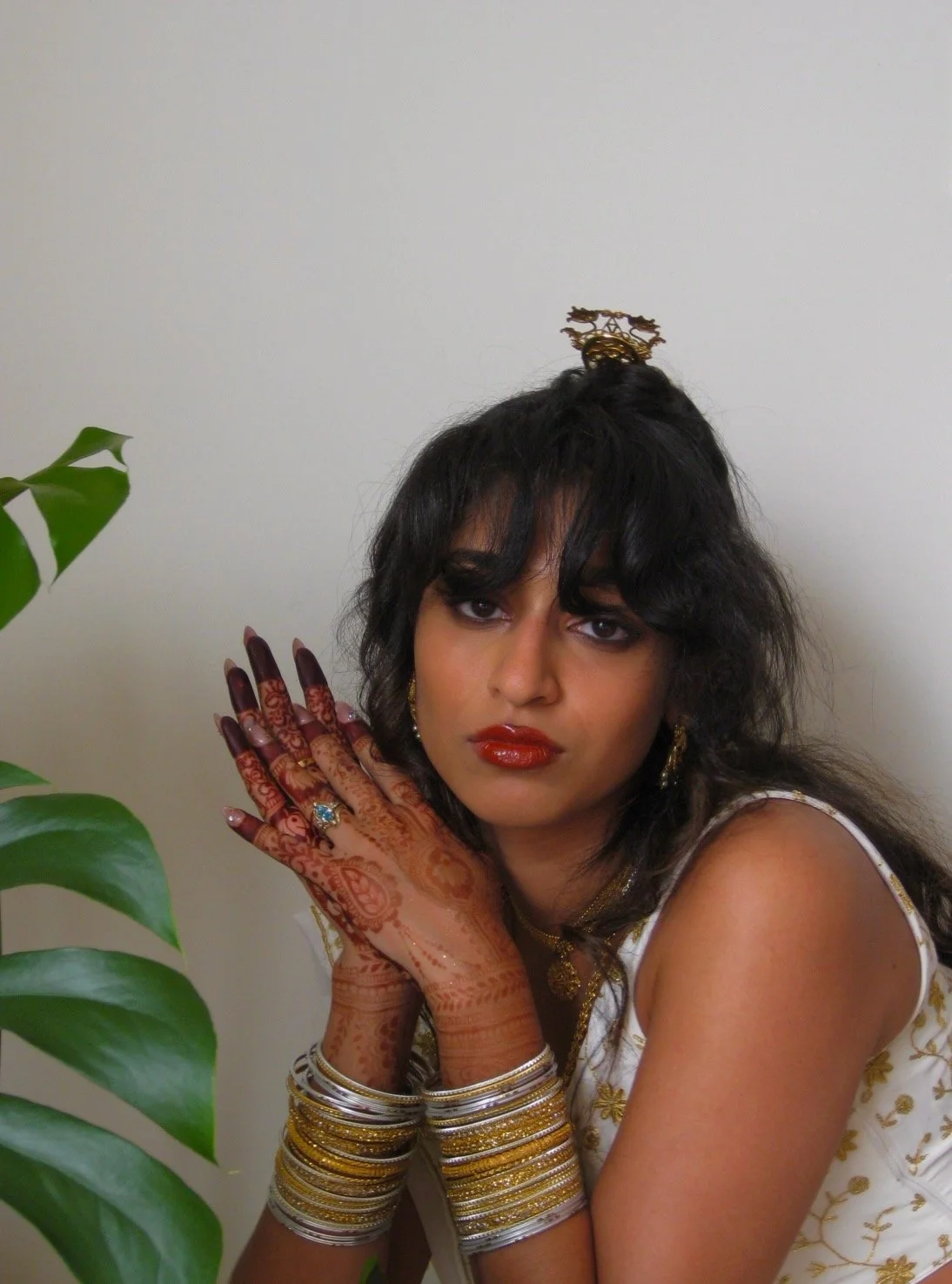
Nishita Naga is an Indian-American fantasy writer based in New York City. Prior to receiving her Creative Writing MA from Royal Holloway University, she worked as a journalist for publications such as CNN and National Geographic. Her literary interests lie in generational narratives with strong political themes in anti-colonization, freedom, and uplifting historically underrepresented voices and narratives. Her work takes great inspiration from the cultures of her heritage, creating an otherworldly backdrop for complex character arcs and political turmoil that bears strong resemblance to real-world power dynamics and their long-lasting effects.