Excerpts from Past the sun (2-4) and Bodied call (5-6)
Francis de Lima
Icarus won't leave, or letter against absolution
When someone moves into your space and won’t leave it's easy to be consumed by the idea of the non-imitable soul such as this shoelace being atoms arranged to be my shoelace. We had all decided to be demons that spring to actually do something for the sake of the oscillations of heat and thunder through the suburb and in it the parakeets thriving off the excess heat. Fundamentally, shooting them seemed both unkind and contrary to the political apparatus of non-state sanctioned violence and none of us owned a gun anyway. Having said that, Icarus was busy trying to glue together a series of carved up floorboards, found in the attic, building a sort of makeshift prism of a rifle. This'll show them he said and we gathered in the kitchen, an inverse town hall, in the sense of it being both not in the center of a town nor open to all. We intimated on the bourgeoisie-inheritance of the townhouse we lived in; it’s possible etymological linkages. Someone had stolen the blueprints for the nearby Amazon Fresh which we planned to rob, until Icarus reminded us that out-of-date groceries were now available in an app. No need for dumpster diving. Just ask the app not to track. I think we should eat our phones but what do I know. At first having him around was a breath of hot air. There's a performance in the first crack of knowing that comes from the presumed tensions in the cartilage of social personhood. Icarus seemed to disagree you're all being fucking stupid, we should be blowing up a pipeline. Crass, naive, the tendency of violent protest becoming just that: the state, remade, in the states image. But the butterflies are disappearing haven't you noticed? I no longer have wings, but rational compassion was never limited to aesthetic similarities anyway. The atoms are no longer compressed. Electrons are watching each other. Sitting next to each other on the bus. The explosion needs to happen. Feedback. Eat the microphone. Eat the sun. We kept mother-in-law’s tongues and spider-plants in every room of the house in hopes of cleaning the air, adding some lungs to the cadaver of the city. But really drops in a petri-dish. Icarus kept sprinkling ash over the plants. I'm trying to immerse you in the experience of the eco-disaster. Eventually, he flooded the shower. Just preparing for the inevitable flooding, New Troy will be the tonsure within an ocean's scalp. And I'm the dandruff. I'm just giving you a taster. Get you acclimated so to speak. You should think about flipping the house. Maybe selling. Buying something in Oxbridge. Sometimes you have to have appropriate distance, we argued. To rest and recover. Self-care is important. We were considering a permaculture garden in the backyard. Cioran says we're always late to our own deaths Icarus declared and smashed every lightbulb in the house. We'll be early this time. Get used to the dark. He kept eating vegan hot wings and making a mess of my couch. Sometimes he did a little dance after sticking them into the dehiscences on his back. Look I can fly again. Look I'm doing my part. Look I'm the butterfly. We were asking him, kindly, to leave. Kept changing the locks to no avail. There he was, every time. Re-reading The Guardian on the couch in the TV-room. Outside the thunder was a closed fist over the sleeping body of the city.
Icarus moves in
In the meeting housemates also
activists also political bodies also
conscious of also of consent being also
a poor and temporary also remedy also
to the notion of also
dying
THE MIND IS A BODY IS A BODY IS A BODY IS A BODY
Icarus wonders about
the dream of consciousness
what remains?
Icarus asks a discarded
coat or gloves arranged in neat piles but
isn't that just
a coatrack?
NO ETHICAL CONSUMPTION NO ETHICAL
two question marks tectonically together
look like a heart so they might
be a heart or a dead pigeon
or so Icarus argues anyway
humour
is easier
than joy
so we laugh
about the
wings
updating
satellite imagery
of the Palisades
and Icarus has chosen
not to leave our house
we have no say
NITROUS OXIDE
the contingent patterning
of the mine shaft in Lancashire
is the corpse of a night well spent
on Earth
beautiful day
to help someone move
in to out of Camberwell
A DYNAMIC ALGORITHM A DYNAMIC A SELF-REPLICATING
Icarus lifts an
oily hessian sack
over my head
in the big house
he has
moved in
on the couch
and won’t leave
the couch
is dripping
seawater
I stand outside the house
with the sack on my head
and scream
BURNING IS BURNING IS BURNING
Icarus stands on the doorstep with a coffee
good. channel
self-immolation.
but remember auto
destruction shouldn't
be a trend. really
believe it.
then they'll
offer you a permanent
contract at
the Starbucks.
Also I've been thinking a lot also
I've been also the ice cores also
the rocks and fossils also the glacial retreat also
ocean acidification also the methane
the ozone also we fixed the also
GRIEF IS A SELF- IS A SELF- IS A REP-
catch us child proofing the sun
NATURALLY THE RADIATION OF THE SUN WOULD BE REFLECTED BACK INTO SPACE
That summer the heat brushed us into the ocean. There is something in the knowledge of the ending. Having said that, the middle might hold fully, in its own right. An attempt to describe the gradient effect of the ocean permeating the boundary of the sky is made, and a successful result is recorded. From within that, the floating islands are an affirmation of a kind of fiction of perception, which we might call beauty, or the extension of the aesthetic experience into the immediate. This is a formulated argument about the notion of memory. What wounds you in the recall is different than what wounds you in the body. Suppose the daily notes are moments of constellation. A child, spending their life on an islet, is apt at naming the rocks jutting from the ocean's note stand. This is neither a question of melody, nor of silence, as those who have come to understand the world through binaries might argue. The spectrum of noise is this: at some point, it coalesces into silence or sound, but really, we are talking about the existence of margins. Moving to the center is what affect means, but we must recall the ability for boundaries to move, which implicitly changes the absolute point of the center. This can be taken as an argument for relativity, but only in moments of oscillation. The waves lap over the granite, until the wind dies down totally. Low atmospheric pressure creates intensely vivid colours by bending air molecules through a prism-like structure. We apply filters to our own sight, both physiologically and cognitively. When we set out for the swim, the water is olive oil, deep in the well of its own colour. The seals have excellent sensory apparatuses and notice us immediately. They emerge, like diacritics, and splash down on the flat back of the water, as soon as we turn. There are six, eight. Young folks, hair down to their backs. Floating, eyes south, the sky is an absolute shade of purple, the facade the only constellation point in the observable periphery, water snapping up the boundaries between the sunglow, aspen, rust, sandstone, saffron, thistle, and heliotrope, into impossibly sharp detail. The only thing in the word is simply cover, the surface, the read. The decision is to recall in the moment, and acts as an anchor-theory into the improbability of existing in breath, in the body, and the ability to access it from afar. Laying down railway sleepers into our own cognition. Being able to retrace a series of steps without missing one seems unlikely, but we do it every day. If we are the sum of concurrent systems, then what might emergence entail? Someone, perched on a rock, waiting for the accent of the seals tail, landed into a body as a unit of labour, observing an ecology, ecstatic at the ability, the desire, to report the impossible totality of their perception.
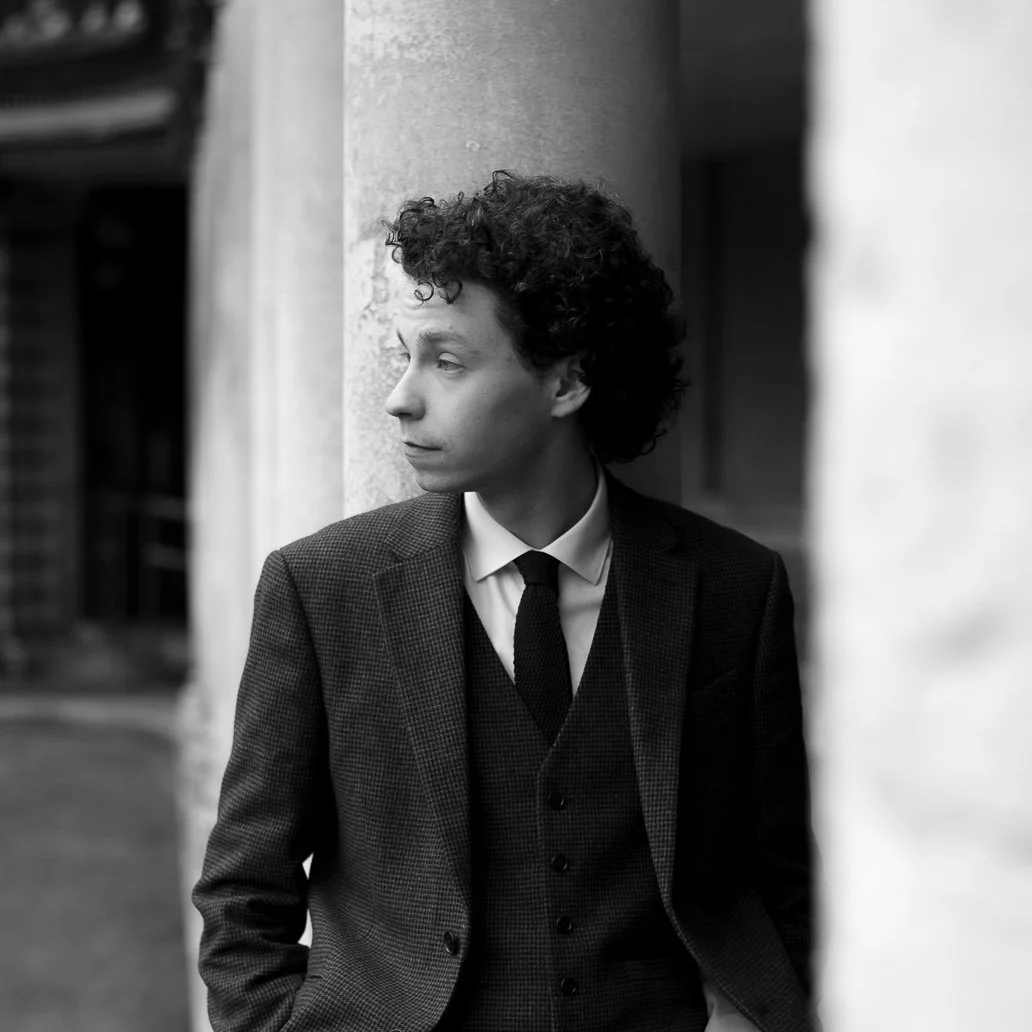
About the author
Francis de Lima is a Finnish-Brazilian poet living in London, where they recently completed their MA in Poetic Practice at Royal Holloway as a Pirkko Koppinen-scholar 2024. Many of their poems can be found in online literature magazines, and some have even been shortlisted for an award or two. They also work as a translator, as well as in various roles within independent theatre, film, and art projects, both in the UK and abroad.