Ministry
Elizabeth Nichol
I.
Not-daughter
‘Child, do you know the meaning of your name?’
‘Rita?’
‘Amrita.’ He rolled the ‘R’ the way my mother did. She had given me that name then taken it with her.
I shook my head.
‘It’s a Sanskrit word. An ancient word. It means “nectar”.’
Other fathers pulled coins from behind ears. Hers took my name and turned it to gold. I was enchanted.
‘There’s more though. Why don’t you two see what you can find?’ He looked around, surveying his kingdom, before pressing his hands deep into his pockets and climbing the stairs to his study.
How long did we spend pulling out volumes? Carrying them to the table like we’d been shown and carefully turning bone-dry pages? Long enough that our dresses became dirty and our summer faces pale with dust. Then, there it was:
The nectar of the devas, granting immortality.
‘So, you drink Amrita and live forever?’ Jeanne said. I looked at her, shrugged. She looked at me, leaned forward and licked my face from jaw to cheek.
My name was something he and I had together, something he bestowed back to me and would now take with him, too. What’s the point of a name when there’s no one left to call you by it? But what a gift to have been given anyway.
I find my right hand pressed to my cheek, ticket in the other. The damp of my coat has steamed up the car, and I spend minutes wiping the windows, my eyes, every blasted thing. At the barrier I roll down the window, push the ticket into the machine and take it when it is poked back out, like a tongue. I’ve already nudged forward by the time I realise the barrier hasn’t opened. I roll the window down again, put the ticket in again. The barrier doesn’t open. A button on the machine offers assistance so I press it, smooth my hair as if they can see me. A voice crackles through: ‘Are you valued?’
‘Excuse me?’
‘Did you validate your ticket? At the machine?’
I look down at the ticket in my hand. I’m sure I did. ‘Yes, I did.’
‘What time did you validate your ticket, madam?’
I retrace my steps. The hours I had spent at his bedside seemed to stretch and overlap. I’d looked up to see Jeanne on the other side, regarding me wolfishly. ‘Yes, well’ – she looked at her watch – ‘It’s gone five, so I expect you’re wanting to be off.’
‘I don’t know,’ I tell the voice. ‘Not long ago. A little after five?’
‘You have ten minutes to leave the car park after you validate your ticket.’
A horn sounds behind me, followed by another. In the rearview mirror: a series of headlights, piercingly bright in the dregs of dusk. When did it get dark? ‘I’m sorry. I don’t understand.’
‘It’s six-thirty, madam.’
I pull at the neck of my jumper. I am suddenly hot, lost.
The next part is chewed by static: ‘...Over an hour…buy another ticket.’
‘But how can I do that? I can’t even turn around. I–’ My phone begins to vibrate. Another horn sounds, longer this time. I search around, rifling through my bag, patting my pockets.
‘You cannot exit this car park without a validated ticket.’
‘Yes, I know, but–’
I find the phone under the passenger seat, its glowing green screen announcing: Mama.
‘Madam?’
‘Mama?’
‘’Scuse me, what’s the problem?’ A man’s face appears in the window, so close I can smell the coffee on his breath.
‘Madam?’ says the voice again.
The man straightens up and yells, ‘She’s on the fucking phone!’ in the direction of his car. I roll the window back up as fast as I can.
‘Rita?’ The phone wriggles from my shaking hand, jumps into the footwell. I hear her voice from a distance. ‘Rita. Are you there?’
The man thumps on the window with a clenched fist. His face, distorted through glass and rain, looks like a mask that hung on the wall in Clifford’s study. ‘What’s that?’ I’d asked, pointing at it.
‘It’s a Kathakali mask. Kathakali is a traditional dance, from Kerala in Southern India. Do you know where your family is from in India, Amrita?’
I’s shaken my head, cheeks burning. I did not know where I came from, but I knew my name. I grope around, find my phone. ‘Mama. I’m here. Is he–’
‘Rita, sweetheart. He’s gone. Just now. He’s gone.’ Her voice is quiet but steady.
I squeeze my eyes shut. ‘I’ll come back.’
‘There’s nothing you can do tonight. Nothing any of us can do, now. Go home. Rest. I’ll call you in–’
The man thumps on the window again. Horns blaze and headlights blink in the mirror. I feel my name, reversing, rising through me again. I fight to keep it down, but it won’t stay, erupting from my throat in a single sob. Because I don’t know what else to do, I press the heels of both hands onto the horn and let it drown out all the others, until my ears ring and my arms ache.
But what a gift to have been given.
In front of me the barrier opens. I put the car in gear, press my foot down and roar out into the blackened day.
II.
Daughter
‘Let’s take a quick recap, shall we? He breathed in some food, and now…,’ Jeanne uncurls a manicured hand above her father, ‘...this.’
The neurologist is calm, slightly tanned, unlike the junior doctors scurrying into side rooms with hunted looks on their faces. ‘It’s not uncommon, I’m afraid. We treated the infection, but your father developed fluid between his lung and ribcage. It’s called a pleural effusion.’
She says nothing, only applies minute adjustments to her face and body and exhales deeply. The result is the communication of profound disappointment – not with her father’s condition so much as with this man personally, as if he’s brought his work to the front of the class and she’s found it to be nothing but doodles of penises. He continues:
‘Unfortunately, that led to a pneumothorax.’
She tilts her head slightly.
‘Chest pain.’
She tilts the other way.
‘We drained the fluid, and he was doing better.’
‘Oh, I see.’
‘But then he developed a UTI. So, we’ve started him on more antibiotics.’
‘Of course you have. And, next?’
‘Now we monitor him.’
‘You misunderstand me, doctor…’ She looks at the name on his badge, decides not to use it. ‘I mean, what new, life-threatening condition can I expect him to have developed when I visit tomorrow? Kidney failure? Sepsis?’
The consultant gives a tight cough. ‘With cases like this, there’s always a risk of complications.’
Jeanne stretches the silence between them as far as it will go, then further still.
‘If you have no further questions then…’
‘Oh, I’m full of questions,’ she says. ‘Primary among them: how close does a man have to be to death to actually be allowed to die?’ He begins to say something, but she holds up a finger. ‘Because it seems to me that he arrived here with a little infection and under your management has very quickly reached death’s door, and you’ – she points – ‘are quite determined to keep him there.’
‘We have a responsibility…’
‘To what? See how much suffering a person can endure?’ She leans forward. He, back. ‘Perhaps you place bets on it, in the consultants’ lounge.’
‘There is no such thing as a consultants’ lounge,’ he says. ‘This is the NHS.’
Jeanne snorts, then begins to laugh. She puts out a hand, signalling him to wait. But the laughter continues, erupts from her until she is wiping black tears from under her eyes. She panics then, that they will turn into real tears, the laughter into heaving sobs, but she catches herself, sighs, straightens up. ‘Yes,’ she says, ‘The National Health Service.’ She gestures once more at her father. ‘And what service, indeed.’
It is the hour when the smells change, when gravy, custard and apple sauce appear on the antibacterial air. Jeanne leans over and sniffs her father’s arm, out of curiosity. Have the fluids shunting through plastic plumbing into his body altered his scent or will he still smell like himself? Like cedarwood bookshelves and old corduroy and the chemist’s best cologne. Neither. He smells utterly benign, as if the person part of him, with its odours and whims and beliefs and everything else of value, has already moved on, leaving his body stuck to this bed. She had been told to ‘grab a coffee’ when they came to wash him, had navigated her way back through the candy-coloured corridors, imagining them rolling him onto his side to dab at the weeping sores on the backs of his legs. When she reached the cafe – a concession of a crappy coffee brand wedged next to an escalator – she had found her mother and Rita there. She’d backed up to watch them, seen Rita’s thin fingers settle on her mother’s arm. Virginia had squeezed, said something inaudible that Jeanne felt with full certainty was, what would I do without you? Yes, Jeanne thought. What would you do without her? While her father had never paid a great deal of attention to Rita when they were children, Virginia had at first welcomed her, then nurtured her, then come to favour her. Once her own relationship with Rita had softly imploded, she’d tried to annex the affections of her father instead. But nothing she could do – good, bad or otherwise – seemed to move him.
‘That your dad?’ The woman in the next bed has propped herself up. Her speech is slurred, but only about as much as her father’s after the first stroke.
‘Yes,’ says Jeanne. She doesn’t feel much in the mood to talk, but it’ll be a relief to look away from him.
‘Bet he was proud of you.’
‘Quite the opposite, I imagine.’
The woman’s laugh is a cough-cackle. ‘Can’t have been as bad as mine. Still, the littluns are a blessing.’ She points to crayon scrawls stuck to the wall above her bed.
‘Your grandchildren?’
‘Great grandchildren. You got kids?’
‘He has one grandchild,’ Jeanne says, inclining her head towards Clifford. ‘Not mine. In fact…’ Jeanne rifles through the cabinet next to his bed and finds a sheet of creamy heavyweight card, on which the message, ‘Love you, Grandpa’, is written in calligraphy, over and over again on faint pencil lines. Jeanne touches a place in her solar plexus, the exact snail-shell shape of Carrie’s baby hand wrapped around her own finger – her singular soft spot. It was only when she met her niece that she knew: if she couldn’t have this child, she wouldn’t have any. Now she wonders whether the girl’s decision to eschew the traditional ‘Get well soon’, might have been prescient. There has always been a knowing in her.
The woman points at the drawer of her cabinet. ‘Look in there.’
Jeanne gets up from her seat and opens the drawer, which is full of trashy TV guides, although there are no TVs on the ward.
‘Under those.’
She finds a packet of Blu Tack and nods at the woman, then sticks the card to the wall above Clifford’s bed.
‘He should have his own room,’ the woman says, ‘It’s not fair, going like that.’
‘Oh, he isn’t going anywhere,’ Jeanne says, wearily. ‘The grim reaper himself could stride in here and these stooges would still order him breakfast.’
The cough-cackle again. ‘Well, m’love, I hope he’ll be on his way soon.’
Jeanne feels a prickle between her shoulder blades. She stands. ‘You too,’ and snaps the paper curtain closed around the bed.
III.
Wife
The chairs have poorly varnished arms and legs, and plastic padded seats, cracked and duct taped. There are even fewer of them this time. I suppose when one gets broken it’s not replaced. A coffee table is marooned on the scuffed linoleum, bearing circular stains in varying shades of raw umber, burnt umber and Van Dyke brown, and a regulation box of tissues. They’re rough, those tissues. I’d tucked one up my sleeve, where it was stubbornly refusing to wilt.
One doesn’t have to look out of a hospital window to know that the view will be of the car park. I find myself scanning it once more for Jeanne’s car, which isn’t difficult to spot, being so vulgar. Come quickly my girl, I say to myself. I can’t do this without you.
There is a mural on one wall. It’s a copy, if you can call it that, of a painting by an artist I recognise. What is his name? Think, Virginia. And is he Polish? No, German. Other works of his pop into my mind: euphoric piglets leaping off docks, a woman taking a giant moth for an evening walk. Here, one giraffe is being rowed around a lake; another – in the water up to its neck – is offered a blue ball. Curious, I think, to offer a ball to a giraffe, who doesn’t have hands but hooves, and underwater hooves at that. The foreground hasn’t been particularly well rendered, so that what I assume should be reeds look like small phalluses, flaccid in the breeze.
The doctor was young, with shadows under her pretty eyes. ‘Does he have a purple form?’ she’d asked, as if he might have slipped whatever that is into his pocket while waiting for the ambulance.
‘A purple form, dear?’ My memory does get patchy. I started to ask her whether it was more lavender or lilac, then thought the better of it.
‘So, no one’s had that conversation with you? About resuscitating him if his heart stops beating?’
I pressed a hand to my own chest. ‘I suppose I imagined if his heart stopped beating, that would be…well…that.’
‘It’s a little more complicated than that,’ she’d said, apologetically.
Drat, I thought. Jeanne will make mincemeat of her.
Dusk is falling outside, but also on the lake. Now while I see the benefit of a little whimsy in such a room as this, I’m struggling to understand why the painter chose to copy a work in which the sun is going down, with its obvious allusions to endings. A little less cobalt, a little more rose, and he (or she) would have us all contemplating a nice new dawn instead. But I suppose that would seem a little disingenuous. What began ten years ago, with a knot of blood the size – so we were told – of a peppercorn, is coming to a close. I am certain of this, and there is nothing any of us can do. Paperwork be damned.
The door handle rattles and I grip the arms of the chair I seem to be sitting on (noting a faint greasiness), but then there is only the sound of footsteps, dying away down the corridor. Michael Sowa! The fright seems to have dislodged the artist’s name from my mental archives. Good to know your brain still works, Virginia. Then it occurs to me that I very likely sat here last time, looked at the giraffes last time, remembered the artist’s name last time (or not) and clean forgot about it. Calling Rita just to ask her if she previously noticed a silly painting is tempting, but also the exact thing that gives people of my age a certain reputation, so I don’t.
Eventually there is no option but to think about the thing I have been trying not to think about: that we were enjoying jelly and ice cream while he was gently warming under his blankets, until a sickly sweat covered his face, and his pyjamas – fresh that morning – were soaked through. He lay shivering, perhaps calling for help in words too misshapen to carry. Was he frightened? If he was here – I mean actually here and not down the corridor – would he blame me? No. No, he wouldn’t. He would take my hand and say, don’t be an old sop, Ginnybean. And then we’d sit together and look at that mural, and he would say I could have done so much better, then segue into the spiritual significance of phallic imagery until I asked him if he wouldn’t mind shutting up.
I return to the window, just in time to see Jeanne’s car tear through the barrier and into the only available space, regardless of the fact a tiny Fiat with its indicator on had begun to inch its way in. She walks towards me with dark coattails flying, then flicks a hand over her shoulder. The car blinks itself locked. I am flooded with many conflicting things when I see Jeanne: love and fear. Awe and – today, at least – gratitude. Not for the first time, I wonder how I made her, which secret parts of me she alchemised into her singular self. There is a tap on the door and for the briefest moment I think I have lost my grip on time and ten minutes have passed in a second. Or that Jeanne has somehow bypassed the lifts and corridors to manifest here in a single moment. Then I remember she wouldn’t knock.
The door opens and a large bottom appears in the gap, followed by the bow of a plastic pinny, and then a trolley loaded with gaudily wrapped snacks. The woman has watery eyes and hair so overdyed it’s nothing but a brassy, fuzzy halo. But her smile hits me quite unexpectedly in my solar plexus.
‘Just thought you might like a tea,’ she says, and I find I require tea quite desperately. ‘Milk and sugar?’
‘A splash of milk please.’
She hands me the paper cup, so scalding I immediately put it on the table and watch a drip travel down and pool around its base. Pale umber. She places a tartan packet of shortbread next to it.
‘Anything else?’ she says.
I think about this for a moment. ‘Actually yes. That painting – has it been here long? Only I’ve been looking at it for hours now…’
‘Funny isn’t it,’ she says. ‘Nice chap he was though. Finished about a month ago I suppose. His mum was on the ward.’
So, I hadn’t seen it before; hadn’t forgotten about it. But I know with certainty that I won’t see it again and grip her arm to steady myself. ‘Did she recover, his mother?’
‘She did in the end.’ She gives my hand a little pat and reverses her trolley back out the door. I imagine her swerving around Jeanne in the corridor, rattling past Clifford in his bed and seeing that he is beyond tea, so far beyond shortbread, and continuing on.
IV.
Granddaughter
The girl hums as she works, a pink triangle of tongue poking out from the side of her mouth. She is deeply absorbed, cross-legged on the floor with a tea tray balanced on her knees, practising her calligraphy. She can sit like this for hours, losing herself in the swoosh and scrape of her special pen, until her bottom goes to sleep and her legs, when she stands, are wobbly, like a newborn foal’s. But it doesn’t matter how deep down she is, when the man in the bed makes a sound, she will feel it in her body like an electric shock and set down her things. He does this now (a soft burp) and in a moment she is there beside him. She takes a handkerchief from the bedside table and wipes away the saliva that is following the crease between cheek and chin. ‘Tut tut, Grandpa,’ she says. ‘You shouldn’t lean your head to the side like that.’ He makes a succession of noises, each tied to the next in verbal bunting, and she closes her eyes to focus. She cannot make out each word. That’s what the grown-ups try to do, and why they never can understand him. You must take the whole line at once; listen to the shape of it, then go very still and – pop! – it comes to you.
I LIKE TO WATCH YOU WORK
She smiles widely and her cheeks turn pink. She looks at the end of the bed. There are pictures, bleached by years, in which he was taller and somewhat wiry, but gravity has pressed him closer to the earth, so she is not surprised to find a foot and a half of cellular blanket beyond the ridge of his feet. ‘Can you hold my tray, Grandpa?’ She balances it on the man’s lap. ‘Careful of the ink.’ She climbs into the space then and folds her legs neatly into position. ‘Ta da!’ She is about to reach across the bed and retrieve the tray, to resume her work, but sees he is looking at it. ‘They’re called oscillating loops,’ she says. ‘It’s just practice.’ He raises his left arm, his good arm, and traces the shape in the air between them. Up and loop and down and loop and up again. Then he jabs his finger into the air. Full stop. A fragment of a nod. ‘Yes!’ she says, ‘I’ll move on to letters soon. But it’s good to practise these.’ He looks like he wants to say something. The words arrive inside her head, like a pebble dropped in a pool. ‘If something’s worth doing, it’s worth doing well,’ she says.
‘Eth,’ he says.
YES
He reaches his hand out and she squeezes it. His returning squeeze is almost imperceptible. Almost. They remain like that for a moment and then she gently lowers his arm back to the bed and settles the tray once more in her lap.
The white winter sun sits blinking behind the trees in the garden when there is a soft knock at the open door and her grandmother appears. ‘Room service!’ she trills. She pushes a doorstop into position with her foot, then pulls in a hostess trolley, on which sits a bowl of mashed potatoes and gravy, a glass of squash with a red-and-white striped straw and a portion of jelly.
She looks up to find her grandmother looking at her. ‘I made far too much. Silly me.’ She winks at the girl, then looks at the tray in her lap. ‘Now this is coming along beautifully.’
‘It’s getting better, my pen-craft,’ the girl says.
‘It certainly is. Now hop down my little gazelle, so we can give Grandpa some afternoon tea.’ They look together to the head of the bed, where his eyes are closed, mouth drooping open. ‘Oh dear,’ she says. ‘I’ve missed the boat.’ But she makes no movement to leave.
‘What is it, Nana?’
‘Oh, nothing.’ But still, she doesn’t move. Eventually she says, ‘When you get married, this is just the furthest thing from your mind. Those early years when you’re having babies and everything is rather chaotic – that’s the easy bit, really. No one ever told me that.’
The girl contemplates this. ‘I don’t ever want to get married. Or have babies.’
‘Good for you, dear.’
The kitchen windows are steamy, so that it feels to the girl like they might be on the bridge of a ship, Grandpa their singular passenger, slumbering in his berth.
‘What will you do then, darling, instead of marrying and having babies?’
The girl feels she has been waiting years for someone to ask her this. ‘Be an artist, like you. Or an anthropologist. Or live on an island.’
‘All wonderful ideas.’
‘I’ll come back though, to visit you and– you and Auntie Je.’
There is a pause in which the girl spoons ice cream into her bowl and her grandmother twists the gold and ruby bands on her ring finger. The radio plays an old song they have heard many times in each other’s company. ‘We’ll always be in raptures to see you, darling.’
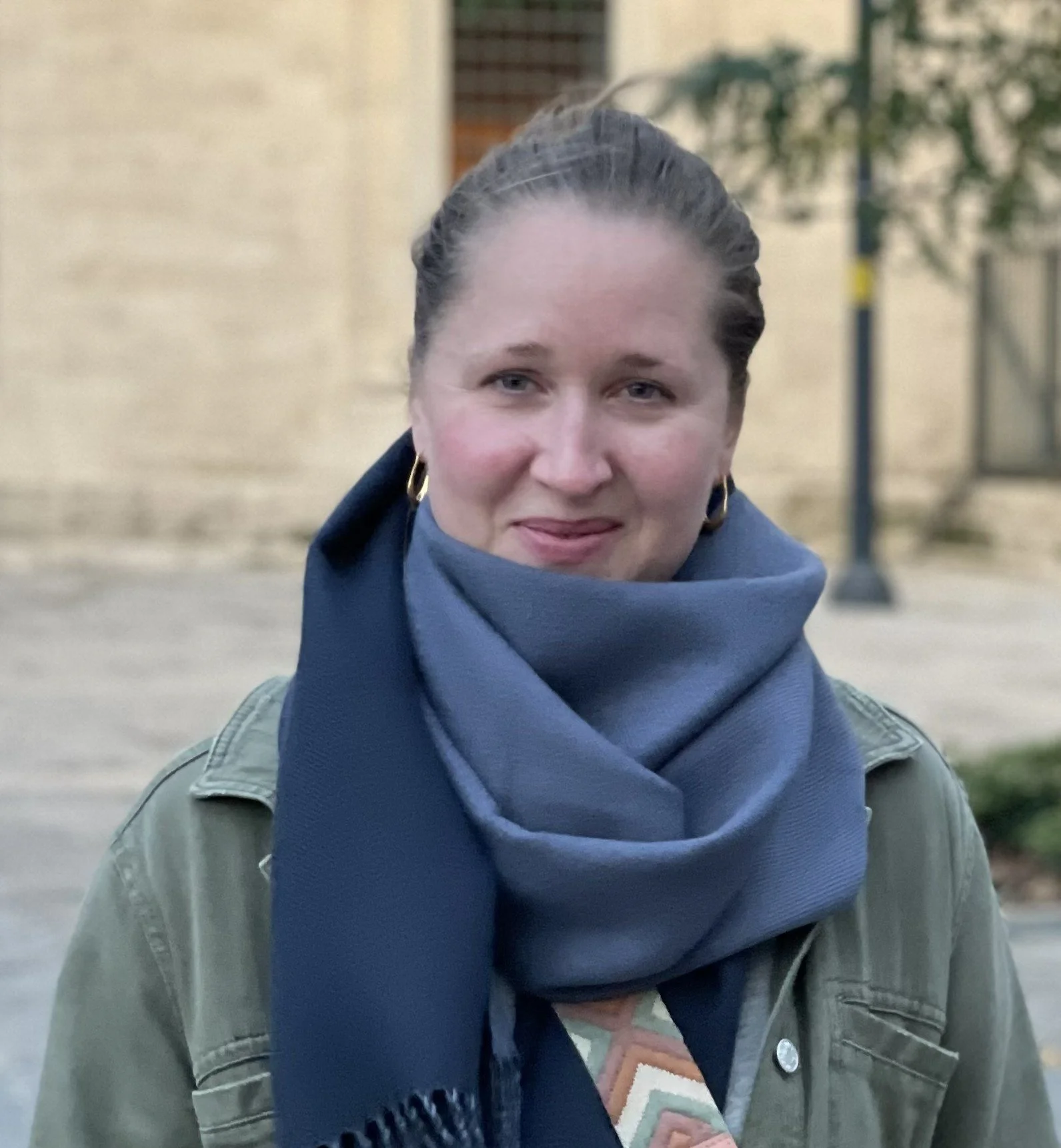
About the author
Lizzy has spent almost 20 years as a copywriter across digital, charity and healthcare, working for brands including Nike, John Lewis and NatWest. The following short story is a prequel to her first novel, Rosevero, which she began during the pandemic and completed in the same month as her Creative Writing MA at Royal Holloway, University of London. Another short story, Truly, was longlisted for The Fish Prize 2025. She lives in Surrey with her husband, two small boys and one large dog, and bakes more bread than they can eat.