Extract from The Family on TV
Amy Collins
Part 1
They aren’t perfect. They aren’t even real. And still I long to be a part of them.
I watch the family on TV at my gran’s house, on weekdays. She sits beside me on a sofa with broken springs. She has changed since I was small; since she was diagnosed with heart failure. Her huggable curves have wasted away to bone. Her hair, once piled high on her head like a cloud, has turned thin and limp. Still, she lathers marmalade on toast with shaky hands and offers me fig rolls the way that you expect grandmas to.
Mum taunts me for the way gran waits on me – like a jealous child. She’s been coming more often to take care of my gran. She rolls her eyes when we put the soaps on: claims they’re a load of rubbish, then gets sucked in every time.
The family on TV aren’t a traditional family. Not like the family I’d once had with my mum, my dad, and my gran. They’re two women: a blonde and a brunette. Both easily beautiful. In their thirties perhaps. A sixteen-year-old daughter, on the blonde’s side. Just a little older than me.
And it's not like I haven’t seen two women on TV before. Had sought out Orange is the New Black when I was thirteen. I had squirmed through the first episode. Felt guilty. Deleted my search history.
But the family on TV had taken me by surprise. Sucked me in where I couldn’t get away. Squashed on the sofa between my mum who couldn’t watch when they came on screen, and my gran who never tried to hide her gag.
Today, they'd finally confessed their love for one another.
I feel giddy and strange walking home from gran’s house. Almost like I’ve confessed my own love. It’s a short walk down a dirt road back to our estate, beneath street lamps and streaking rain.
My mum walks quietly on the other side of the road, focused on keeping her hair dry beneath her hood. Her face is harsh with its edges, like my grans: a long slim nose and a jawline cut sharp.
‘I’m glad they got together,’ I blurt out. But the wind swallows it up.
‘What?’ Mum says, irritated to be turning her face towards me. Into the rain.
Suddenly I’m grateful for the dusk hiding the pink in my cheeks, the little bounce in my stride.
‘On TV… the two women… it’s nice,’ I cringe.
Mum turns her eyes back to the road. ‘I suppose,’ she shrugs.
I don’t bother trying again. She has been hard to reach since dad left.
Later I sit cross legged in my bunkbed. Watch the shadows of trees ticking on my bedroom wall.
The truth is the family on TV have made me think of love.
There’s a girl in my class. White blonde hair, eyes a mix of hazel and green like a cat. She sits in the front row next to the window and the sun, which is low and golden at this time of year.
She walks home down the same backroads I walk home. Past cobbled cottages and a pretty white mare who sways back and forth in her stable. Sometimes after class, I can’t help myself. I walk fast and catch her up. Pretend I’ve not noticed her until she calls my name, links our arms.
She trusts me easily. Perhaps because I’m not popular the way she is, and why should I care that she gets giddy talking about that silly video game, Skyrim? That she seems so self assured telling me I could be a high elf because I’m tall and graceful and golden blonde. Makes me splutter my laughter.
‘It’s brown, really. I’ve not been blonde since I was a kid.’
She takes a bit of it between her fingers; holds it into the sun, where its loops glow gold like tiny halos.
‘See, it’s blonde,’ she says, smug. Takes care tucking my hair back into place behind my ear.
I can hardly think of a witty response because I’m blushing. Thinking of her hand in my hair. On my cheek. On my waist. And it’s silly – it’s only a hand in my hair. It puts a knot in my belly.
I retreat to the family on TV.
And perhaps it’s on purpose that evening: the way I smile wide when the women on TV hold hands over the breakfast bar, or cradle their daughter in a group hug on the sofa.
They talk about spending Christmas together in a way which makes my heart do leaps. The brunette insists it’ll be takeaway on the sofa; that she’s not getting up at 7 o’clock to peel Brussel sprouts.
It’s much simpler than our Christmases. With the turkey and the chocolate yule log and the aunts and uncles from up country I barely know; mum’s hand on my head as she tells them how well I’m doing in school, though I don’t remember the last time she asked.
It’s during the adverts that gran turns to me, eyes bulged by her reading glasses.
‘They’re weird, aren’t they?’ She says.
I pause. Think of letting it go. But she’s been quieter today – has barely made a gag or a comment, and it has made me hopeful.
‘I think it’s okay,’ I say carefully.
She turns back to the knitting in her lap. I watch her pale hands work the needles.
I try again. ‘I think it’s okay… like there’s nothing wrong with being…’
‘It’s not in God’s design,’ she says, voice creaking with frustration.
And I want to tell her that I think God would love me, anyway. That I talk to him sometimes in the night when I feel sad, and it’s nice. I feel less lonely.
She composes herself. ‘You know, if you turned out like that lot on the telly, I could never forgive you.’
She says it with a quiet laugh, and it makes me squirm. I sink into the sofa.
‘Mhm,’ I say. Look down at my lap, at the toast she made me, marmalade oozing in a little orange puddle on the plate.
She pulls me in. Presses a slobbery kiss to my head. ‘You’re a good girl,’ she says. And I try not to scrub her kiss from my hair.
I cry quietly on the way home. My chest burns from holding sobs back. Still, mum notices. Watches my heavy breaths in the Autumn air. She’s jittery. Agitated. She’s always this way when I cry. She talks over the wind about how tired she is; about how she has to take care of my gran all by herself, and how hard its all been for her since dad went.
I feel my tears grow desperate and hot. It isn’t even that I want her to stand up for me. I just want her to say something. Say anything. Because I know she knows. That, in the past, she had always turned rigid and aloof when I was mooning over the models in the perfume advertisements in Boots, or pining over my English teacher who had always been affectionate and kind to me.
Mum opens her mouth. Then closes it again. I grow hopeful.
‘I told you she was a bitch,’ she says quietly.
I deflate. It should be a comfort. It feels like an ‘I told you so.’
We stay quiet the rest of the way home. We have reached the estate by then, and our feet slap painfully loud on the concrete.
My mind drifts to the blonde woman on TV: the mother. I think of the way she hugs her daughter when she cries. The way she holds her face like a precious jewel, catches her tears with the pads of her thumbs.
I picture her holding me the same.
Part 2
And I suppose I would say I love them, if it wasn’t so bizarre to love people who don’t exist.
But what else would you call it? Waking up in dark winter mornings thinking of them. Waiting through each day – each class, each meal, each conversation – to get to them on the telly.
On the sofa between mum and gran, I feel colder now; draw my legs to my chest so our knees won’t knock. And I try to figure out what it is about the family on TV. Because it’s not just that they are like me.
Perhaps it’s the ease with which they seem to love. It seeps into their every movement; kisses to the head just for coming and going, affectionately swatted bottoms, and hugs which swallow you whole. And I know – I know – all families love each other differently. And still, I don’t remember – I’m not sure there was ever—a time where mum could touch me like that. Even before my dad left us, she was fragile and aloof. But he was not a good man to her.
Mum taps my shoulder, pulls me from the telly. ‘Can you grab me some kitchen roll?’ She says.
She’s kneeling in front of my gran, rolling her stockings down her calves. Her legs are swollen and red, black veins cutting through them like sun cracks.
Too quickly, I want to snap. Why? Why can’t you get it yourself? Why are you trying to ruin this for me? I know it isn’t rational, but I’ve been irritable around her more and more.
She gestures towards my gran, who is dribbling soup down her chin. She’s been sicker these last weeks. She’ll hardly feed herself until we come, so mum mixes her soup from a packet but never puts enough water in so it sits like sludge in the bowl.
I bring the kitchen roll quickly, eager to get back to the TV.
‘You didn’t need to bring the whole roll,’ mum says. She’s teasing me, I think. She would tease me often when I was small. ’How much soup do you think she’s had?’ She laughs as if she’d like me to laugh with her.
‘Sorry,’ I say awkwardly, and tear off a square.
Gran watches me carefully – expectantly – grey eyes milky with cataracts, chin glistening with remnants of soup and saliva. And I hate that – I can’t stand that – I’m overcome with a sudden disgust; at the wetness which seeps through the kitchen roll and sticks to my fingers, at the wrinkles thatched on her face I would trace the lines of as a child.
‘I’m a pathetic sight, aren’t I?’ She laughs uneasily. I think I see tears clouding her eyes.
She takes the kitchen roll from me and wipes blindly at her chin. I excuse myself to the kitchen to wash my hands. I stand over the sink, steam curling from its basin, and massage suds into my hands and wrists.
And I wonder when I turned so cruel.
It eats away at me. That night in my bunkbed, beneath the smothering heat of the quilt, I send a prayer that I don’t lose her.
She wouldn’t want me anyway if she knew.
I roll over again. Kick at the quilt with my feet. I can never sleep without the weight of it, but my body is always slick with sweat.
I tell myself I’m being silly. She’s nearly eighty. Of course she thinks I’m not right. It’s usual for people in her generation to think that way.
I think of all the ways she has loved me before. Mum lists them often: how together they’ve clothed me, kept a roof over my head, they’d never let me go hungry. And still, I can hardly look at them. Can’t will away the bitterness which cools and hardens in my body.
I go to the library after school more and more. I never plan to, but always find my legs carry me up the stairwell after the final bell rings. I tell mum and gran it’s afterschool clubs, or revision sessions which run late into the evening. Try not to picture my gran waiting patiently for me, shrivelled into the sofa with a plate of marmalade on toast in her lap.
Most people avoid the library. It has an eerie feeling about it. The panelled lights on the ceiling are fluorescent, clinical, and flicker in a way which makes my head hurt. But it’s peaceful. Sits at the highest point in the school with a view of the tennis courts and the seagulls which swoop over it collecting scraps from the day.
I curl into a damp smelling beanbag between the bookshelves. And on my phone in the library, I greedily watch scenes of the family over and over again. I memorise every kiss, every laugh, each crease which sculpts their faces. The words they say – their lines – I repeat them just to feel the shape of them in my mouth.
When I am certain even the librarian is gone for the day, and the shadows of night stretch across the room, I pluck them from behind the screen.
When the TV family put the Christmas tree up, and when the librarian threads silver tinsel through the bookshelves, I realise that the school holidays are looming. I picture the tattered Christmas tree in the library against the sleek, snow-dusted tree in their living room. I picture us cross-legged next to it, exchanging presents, small and thoughtful. I picture what I might get them. What might make them smile. Some dainty jewellery for the blonde and her daughter. The blonde woman leans down and parts my hair with her nose. And it’s perfect.
I move in a fog of these thoughts. Find that I’m barely there in class, in conversations, on the days I do see mum and gran.
I talk to them sometimes when I’m alone, which becomes much more often. Words of an imagined conversation tip easily from my mouth as I walk home down the backroads.
‘I wish you were here,’ I say one time.
My footsteps falter.
It somehow feels sillier and more embarrassing to say than the rest. Because I know more than anything that they won’t – they can’t. And for a moment, the quiet – the birdsong and the rain – leaves me hollow.
I think it would be perfect, if it was real.
After the final bell one day, the girl from class pushes through the heavy library doors. Her hair is stringy and limp from the rain. She battles with its heaviness as she scrapes it into a ponytail.
She takes me by surprise. I haven’t spoken to her in weeks – haven’t tried to.
I could only cringe and squirm at myself for the way I’d been. I’m unsure how to react as she smiles shyly, moves carefully towards me like I’m a stray cat she’s trying to lure. She leans against the edge of the bookshelf.
‘I saw you come up,’ she says. She fiddles with the buttons of her cardigan. ‘I’ve not seen you properly in ages.’
I try, and fail, not to smile dumbly at the thought of her following me up here. ‘I’m sorry,’ I say. ‘I don’t mean to be a bad friend,’ I force out.
She smiles back at me, her lips red and cracked from her lip balm and the cold. ‘What are you doing up here?’ She grimaces at the well-trampled carpet, pokes a piece of dried up gum with her shoe. ‘It’s gross.’
I dip my head shamefully. Though she couldn’t possibly know about the TV family, I feel exposed beneath her eyes. I search for an excuse. Scan the bookshelf by my head and catch sight of one of the book spines: Tess of the d’Urbervilles.
'I’ve been reading for A-Levels… English,’ I say.
She gives me a sceptical look – like the one teachers give you when they know you’re lying.
‘I want to do English Lit as well,’ she says quietly, swaying on her feet a little. And then, quiet enough that it feels confessional: “perhaps we could read together?’
For a moment, my mind disappears back to our English classroom a year on. I sit next to her in the front row, the sun boiling our backs through the window. The A-Level classes are much smaller. We’ll be able to talk more. I’ll make her laugh. I like her laugh and how it’s musical like wind chimes.
I squash the thought.
She collapses next to me on the beanbag, ends up slumping into my side. Close enough that I can feel her wet breath on my neck. She laughs and looks up at me, the whites of her eyes shining in the grainy dark.
And she’s beautiful. But suddenly her nearness feels like suffocating, as though I’m a newborn lamb left in its sac.
I feel it building in me: the anger. The desire to push her off of me. She’s ruining it. She’s ruining it. This is my time alone with the family, and she’s ruining it.
As she watches me with gentle eyes, I silently plead with her to go away. I only deserve to be alone with the family.
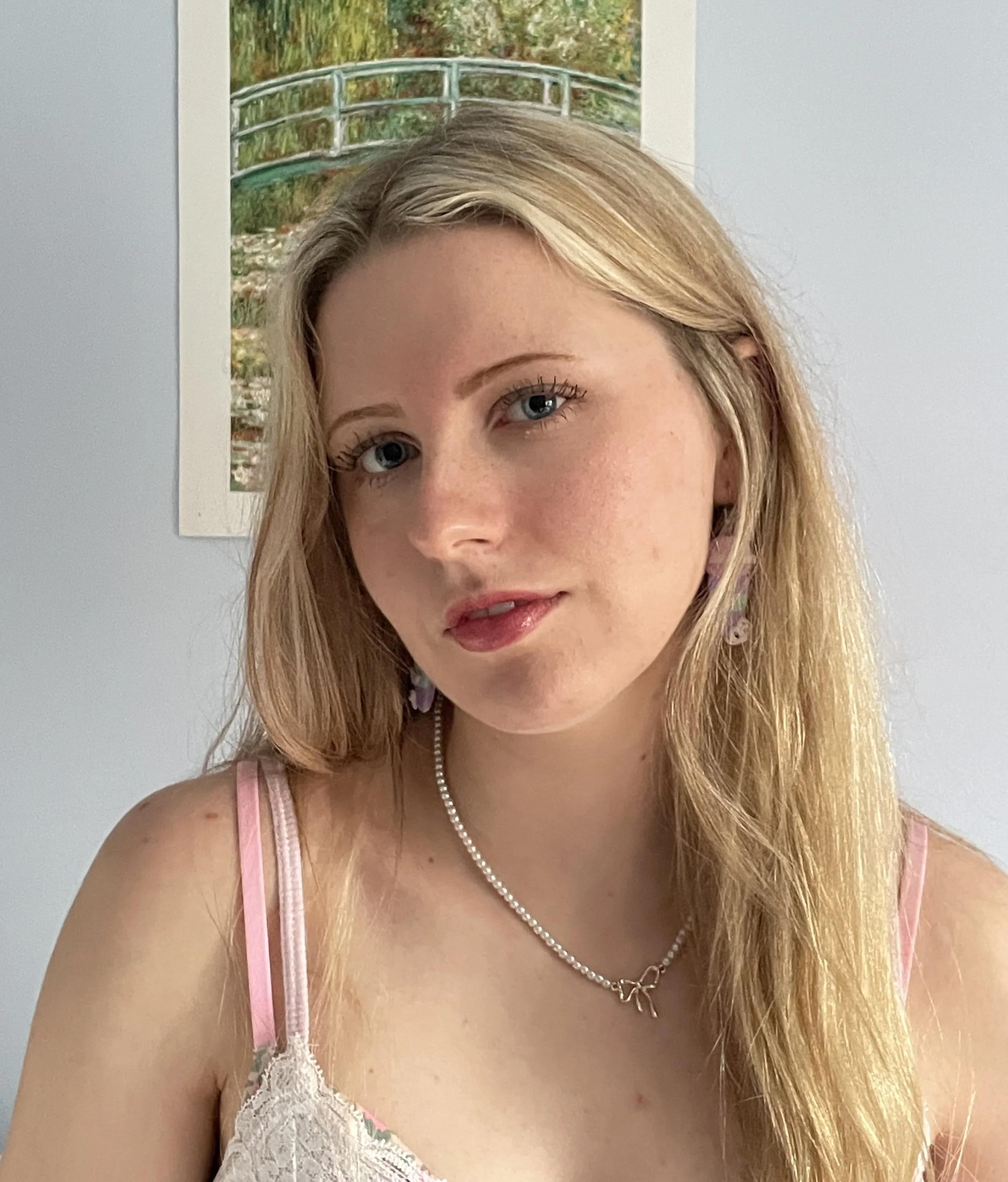
About the author
Amy Collins is a writer of literary fiction currently located in Cornwall. Whilst initially beginning her writing journey with a keen interest in Cornish folklore and children’s literature, during her time on the Royal Holloway MA course she has grown captivated by close character work and the complexities of the adolescent mind. Having grown up in Cornwall (although she hated the beach as a child) the rugged Cornish landscape is prominent in Amy’s work not only as a backdrop, but as an amplifier of loneliness, despair, and from time to time, joy. Her fiction is attentive to intimate moments and small gestures, exploring the subtle ways in which memory, longing, and human connection shape the lives we lead
Whilst Amy is also currently working on her first novel, Miss Marks, this extract from The Family on TV follows a teenage protagonist who is reckoning and struggling not only with her queerness, but a desire to be seen. Consequently, she grows increasingly involved in a parasocial relationship with a family she watches on TV, and increasingly wary of the human connection her body craves.