Forever Green
Abigail Shaw
We have many jam jars on our little shelf in the kitchen. The shelf is blue from the paint can out back and the jars are all empty. Grandma washed them clean in the sink and they misted where she screwed the lid on to let them dry. She says they are waiting for our adventures. Frogspawn, buttons, mud water potions, and little river fish. But I think she is saving them for the songs. It’s been a long time since she heard one. She says we must wait for the Muse but I do not know who that is. I know it is not Cecil. Grandma says she won’t live another day, and it is all Cecil’s fault.
Cecil came to our town once when I was half as tall as I am now. He wore a tweed suit and a cream trilby with a black ribbon tied around its waist. Bicycle boy, summer’s son, he rode up and round the country, gathering the songs. He did not know about the jam jars. Or the way the wind curled the notes like ivy around the trees. He did not know about the hum, or the dance, or the fumble for the tune. He brought pocketbooks and lead, spread the songs flat across the pages, and hung them silent and still – dead beasts of the forest. He left out the snap, the quick-step thump, the late thud of the clog, and he lost us the music. People stopped listening with their ears and hearts, started hearing with their eyes. They forgot about the space around the song and could not remember why they sung.
‘He ignored the singers for the song that man,’ Grandma told me once. She was concerned with the lack of clinking, she said: ‘He didn’t clack none like the jars. He chose paper over people and told the Music what it ought to be. It didn’t like that. Music don’t like to be hunted.’
So the music crept away. The songs sunk into the earth, and the heart rhythms stilled their beating in the wood. There were no more dances. The theatre with the big velvet curtains grew dusty and the cider ran dry. Buskers came down with stiff fingers, started playing the same notes every time. People got bored, stopped listening, stopped dancing, the money ran out and the music turned in until there was nothing left. Nothing but the jam jars on our shelf, and Grandma’s dancing dresses.
Sometimes in spring, if the air is cool and still, an old trunk turned table in the back of the pub can remember how the old songs went. Woody’ll beat out a line or two, recall a lost forgotten word. But by morning, as the mist sets in and drifts overland, the jars are still empty, and no one remembers why they sang.
Woody used to play on the radio when they were still playing music. There’s an old memory I have of that station, all golden and green: Grandma sits in the front passenger seat with Joni behind the wheel. Joni is learning how to drive and she’s shaking like a tulip in the frost, all unbelonging and thinking of death. Only it’s midsummer and the sun’s been burning up her nose for days. There’s a white flap of skin I want to pull off her forehead and stick to the window next to mine. It will be like the pretty windows in the church. Grandma calls them stained glass and I wonder how much skin it would take to fill a church. I want to ask her, but she tells me to shush: ‘Joni is concentrating, love.’ So I sit quietly, watching Joni’s forehead.
She’s all bunched up small against the wheel so when she presses the pedals her knees go sideways. I laugh because she reminds me of the funny man with the puppets on the string, and Grandma shouts at me because I am rude. Joni tries not to cry.
‘It's alright, Joni-love,’ Grandma says. ‘Just lean back against the seat. Relax.’
She pushes the little silver button on the dash for the aircon and flicks the radio on as an afterthought. Woody’s twang comes on and his harmonica rattles over the speakers, filling the car. He straightens out Joni’s back with his singing voice so her dress with the yellow flowers hangs flat like a proper meadow, not crumpled around her knees. The sunlight comes in gold, balancing a smooth line with the field’s green, and Grandma hums along with Woody until we reach home.
‘I ain’t never heard a song like that,’ says Joni when we get back. ‘I need that man singing to me all the time—soothes the nerves.’
‘Stick to the music, love,’ Grandma laughs. ‘All a man’ll do is cause you more stress. Then you’ll be callin’ for the music again and again. You’ll run it all out. Won’t be none left for the rest of us.’
We never got to see if Joni used the music up. Cecil came and scared the notes away, the radio shut down, and Woody started working for a power company. She didn’t think him so pretty then. Or anyone, for that matter. I asked Grandma once why Joni didn’t have no beau, but she shushed me thinking Joni heard and would slap me.
Later, before bed, she told me it was because there were no more dances.
‘You can’t dance without no music, love. Well, you can but they’ll think you’ve gone round the bend. An’ the dances? They’re for the love thing. It’s what the birds do in the forest. They go dancin’ and dancin’ around those trees with their feathers fluttrin’ and their chests all pumped purple. They’ve got music in that forest still. Nature’s music they be callin’ it. All music starts off natural like – that’s where the Muse comes from. Someone better wake her up if you ask me.’
Grandma keeps her old dancing dresses in the big wardrobe. They’re hidden away like a warm summer at the end of the dark thickets of blazers and suits. Polka dot, daisy, satin, swing, bedazzled and bejewelled. They smell sweet and smoky with cigars and perfume. When I smell them, I inhale all the colours and imagine a tree with thin cigarette branches, brown and rolled, dotted with orange fruit. It has no leaves; a haze of cigar smoke fills in the curls.
When the music first went away, she tried them all on, just once, and then put them away for good. I saw her with a red and blue checked dress, the kind that ties in tight at the waist and fills outwards like a bell. It bloomed in the silence as she spun, her eyes closed and remembering. She looked so small, but her smile was so big. I could not hear the music, but I thought it must be beautiful. She stopped when she saw me watching from the doorway and put it back next to the others. I asked to see it again, but she says it’s no good watching her twirl without the music. It’s wrong to dance alone.
She did show me the butterfly clip hidden in her sock drawer though. It fluttered green in the half-light. She called it a cheeky bugger that twirled her into all sorts of dances and told me it winked in jazz. I asked her what she meant by ‘jazz’, but it only made her sad.
‘It’s like when I bake the cookies and give ‘em to Joni. Joni ices ‘em white and passes ‘em on to you and you do all the sprinkles. It’s all the same cookies in different ways, see?’
I shook my head.
‘Or like the jam jars, love. I spread the jam out on your toast, thick ‘n sweet until there’s none left, wash it out and start again. Same jar, different flavour. Keeps the berries growin’ and your tongue wantin’. You ain’t never tasted the same thing twice. An’ that’s why it tastes so good.’
Grandma put the clip away under her socks. I wanted to show it to Joni and tell her about the biscuits and the jazz, but I’m not allowed in that drawer. It’s where Grandma keeps her underwear. Besides, she has no need for the dresses or the butterfly clip now. All the dancing halls are closed.
On Thursday Grandma got sick. She usually does in winter when they bring the logs in for the fires. Her nose goes dripping all over town and our house, and she makes paper tissues come out her sleeve like the funny man. Only he deals in rainbows and hers are all white like snow. She makes a pot of tea to hunch over, and another with honey for her throat. She wraps her head up in a thick green scarf that she used to wear dancing and eats chicken soup for a week. I hate it when Grandma’s ill because I must be quiet, and Joni won’t make any other kind of soup. Grandma knows her body well – she says her bones don’t creak, they speak – and she’s always well enough to bake cookies or play by the end of the week.
But this time’s different. Grandma sits in bed all day and night and will not eat the soup, even if I blow on it to cool, or Joni lifts a spoon to her mouth. She just sits and waits and pushes the spoon away.
‘Not now, Joni-love,’ she says. ‘I’m waiting.’
Joni asked her what she’s waiting for, but she never tells Joni nothing; she says Joni worries too much. I waited for Joni and the chicken soup to leave so I wouldn’t have to drink it because Grandma couldn’t, and I asked Grandma what she was waiting for.
‘I’m dying, love,’ she told me and put her hand on top of mine. ‘My life’s all one big dance and the music’s gone away. I’m just waiting for the swansong, love, I’m just waiting for the Muse.’
She closed her eyes after that, but I could still feel her heart beating where her hand covered mine. Grandma says she won’t live another day, and it’s all Cecil’s fault because he scared away the music. But I am going to bring it back again, for Grandma, so she can go on dancing.
Grandma says the Muse lives in the forest. The forest is different to the woods – the woods are where we get our firewood from. They are tame and nothing in there will kill you because it has been bitten too many times by the axe. The forest is green and wild, and no one knows what lives there anymore. The birds flew over when we started chopping trees and Woody says he saw a beast with five legs and three tails go running when he sang the last song.
Joni says it’s nonsense. ‘A bit of fancy,’ she calls it. But I know she is afraid and believes it somewhere in her bones because, whenever we go collecting the logs, she always makes excuses. The sink needs a scrub, the floor wants a mopping, or the clothes must be folded before the moths come in. I have never seen a moth inside our house.
Grandma says, ‘Oh let ‘er be,’ and we go logging just us. I don’t mind it just us, but Woody’s stories do darken the road some, even with Grandma’s hand in mine. Now I must go alone because Joni doesn’t understand and, even if she did, she wouldn’t go.
I go upstairs to Grandma’s room where she is fast asleep and carefully open the wardrobe with all her dancing dresses without her waking.
The Muse must be beautiful to make such loved music and demand such pretty dresses. I want her to like me when I find her, I want her to understand. I will tap her on the shoulder, and when she wakes up from her sleep, bleary-eyed and beautiful, she will see Grandma’s dancing dress and remember the music. She is golden and green like that day with the music, I decide. Her hair is sunlight and her dress meadow grass. Her eyes are as brown as the earth, and she will make music again.
I pick out the red and blue dress and put it on. Grandma was not much taller than me in her dancing years, and it fits well. Downstairs I fill a basket with the jam jars (to gather the songs), pull on my red coat and push Grandma’s green scarf round my shoulders for good measure against the cold. I do not tell Joni that I am going – she worries too much.
Outside everything is white with snow. There are tracks leading to the front door where Joni brought in the milk before it froze in the bottle, but there are no tracks going away. The milkman’s boots are snowed over and by now his cart will be snowed in. I pull the door closed behind me – we do not lock it anymore. Thieves don’t come in wintertime; everyone stays in from the cold. Only drunks and idiots would make that blunder in winter. They come when the earth is warm, and the houses sweat people out into gardens and fields. Cecil came in summertime, but he was a fool for other reasons.
I make snow tracks from our house to the woods and then all the way from the woods to where Grandma says the forest begins. The forest has a different kind of tree to the woods. The woods are all ash – they grow broad-fingered and layered like brown scales in summer. They fall and sleep in wintertime and the snow blankets tuck them in. But the trees in the forest – they are forever green. I stand at the edge and stare at the ring of earth where the pine needles stop the snow from falling. It’s like the forest breathed out a sigh and thawed a perfect circle around itself. I make sure the jam jars are snug in the basket, and step over the line.
There are many things in the forest I haven’t seen before. Toad stalls, red and spotted, with real toads perched on their shells. They watch me glumly with their wide flat eyes and croak in unison. When I try and get a closer look they hop two feet into the air, throats bulging, swiping at my nose with their wet feet. I tell them to not be so rude, or I’ll put them in my jam jar and screw the lid on tight. They will not like that.
There are flowers here, even in winter. They look exactly like the bluebells Joni grows in her little planter in spring, except they are gold instead of deep purple. I bend to get a closer look and tickle one with my finger. It lets out a soft chime like a tiny bell. I unscrew one of the jam jars and break the stem a finger above the ground, just like Joni does when she makes up the vase on the kitchen table. She says it’s important to cut them right or they’ll quit living before you get them to the house. It fits perfectly in the jar. I shake it gently and listen to its golden singing. Beautiful.
Grandma will smile, but it’s not enough to make her dance. Not yet. There are daffodil trumpets, foxglove flutes, xylophone ferns, and crinkled leaves. I’ll gather all the sounds into the jam jars for the Muse, and she’ll brew the Music. We’re allowed to gather, it’s the hunting or making that’s wrong. Woody tried making up a song once when the music went away. It turned him funny, made his toenails shrink in his boots and his throat nicker like a horse. He stopped halfway and refused to sing anymore.
I turn to the toad chorus – if I can get the smallest to budge, those toad stalls would make excellent drums. I wedge the jam jar with the bells back into the basket and tell the littlest toad to hop aside. He stares at me and then a long pink string of a tongue pokes out the corner of his mouth. It rolls between his lips and then shoots at my face, hitting me right in the eye. The other toads croak in laughter and hop onto my head. They pummel me with their slippery, wet feet and dance all over my back. One dives into the basket. I see him wrap his tongue around the jam jar with the bells and leap for freedom. Before I can reach after him, he’s hopped away. The other toads bound after him into the undergrowth.
I pat down my hair and check the basket. There’re still four jars left – plenty for gathering. I check that the toads have really gone this time but there isn’t a croak in sight. I bend down to pluck another flower.
‘Do you not learn?’
I fall forward onto my and knees, the golden bell clutched in my hands, and scurry back to my feet in alarm. ‘Who’s there?’ I ask. I don’t recognise the voice, and I know everyone in town. Grandma made sure of that – she said everyone should see my pretty face, so I stuck my tongue out at her.
‘I asked, do you not learn?’ the voice repeats and a creature with the face of a hare and the body of a deer steps out from the forever green. It stands on all fours with a beard of moss and a ribcage made from dead branches. Antlers twice the size of my arms stick out behind two long ears and, where its hooves should be, it stands on four human hands.
I try to put the golden bell back in the earth because I do not like the way the creature is looking at me, but the bells won’t stand straight.
‘I do learn,’ I tell it. Because it is true, and I am more angry than afraid. Grandma taught me all the letters and the numbers, and I can spell better than all the children in my class. Even Joni says I’m difficult to keep up with. I am not stupid, and the creature shouldn’t think it.
‘Then you must not take the flowers, or the leaves, or anything in the forest. They do not belong to you.’
‘No.’ I nod. ‘They belong to the Muse.’
That’ll show him – I do know some things.
‘I’m taking them to her so she will bring the Music back again,’ I say.
I did not know hares could frown, but I guess he isn’t really a hare. Not a whole hare, at least. He frowns at me. Then he smiles, a big wide grin with all kinds of teeth: pointy little mouse teeth and large rounded cow molars, a row of diamond sharks’ teeth and white-yellowed bear canines. I can even see the beginnings of a small tusk from his upper lip.
‘There is no Muse in this forest,’ he says to me. ‘But I can bring the Music back again. Come, I’ll show you how to sing.’
‘And dance?’ I ask because the dancing is what Grandma loves.
‘Oh, we will make them dance,’ he says. ‘Come, I’ll show you how to play.’
He takes me to the heart of the forest where the Music is strongest, and you can feel the rhythms pounding in the earth. You must always be on guard when you stand in the middle of the trees, or the rhythms’ pulse will push you up and over and under the roots and you’ll never stop dancing. He asks for the jam jars, and he smashes all but one. He runs his antler through my heart, holding it steady with one human hand. I watch a silver sliver of a ghost snake into the jar. It lies coiled in the bottom and he tells me it is my soul. He screws on the lid and breathes a song into the hole in my heart where my soul used to be.
‘Muse,’ is what he calls me. ‘You’re the Muse of the Music now.’
He says I must not open the jam jar again or they will see the real Me. They will see that I am real, and they will think me ugly. He says they will stick horns on my head and a tail on my back. They will send me away to the forest and there will be no more music again.
When I get home Joni is washing the plates. I put the jam jar on the shelf. It looks bigger than I remember without the others standing next to it.
‘That’s a pretty dress,’ Joni says. ‘Go on, give us a twirl.’
I spin for Joni, I spin and I spin. The dress fills out the room blue and red like flames and it is so pretty I forget that it was Grandma’s first. I open my mouth to laugh and a tune flows out, golden and green.
‘Is that a new song?’ Grandma calls from the doorway. She is red around the nose from sneezing, but she looks younger than she has in years.
‘Yes, Grandma,’ I say. ‘I made it for you.’
Grandma dances in the kitchen, and dances around the house. She tries on all her dancing dresses and makes Joni drive us into town.
‘Everyone must hear the new song,’ she says. ‘They must all hear you sing.’
I sing for the townspeople, I sing for the mayor. I sing for Woody and all the children in my class. They take all the pews out of the churches and put them in the park. Woody builds a big stage with red velvet curtains and a microphone just for me. They listen to me sing all day and they make me sing all night until my throat hurts and I want to go home. It is cold out in the snow and my bed is warm and snug. The snow turns to slush from all the dancing, and their feet pound the grass to death, but still they make me sing on; they have forgotten that I am real.
They will dance forever, I think.
About the author
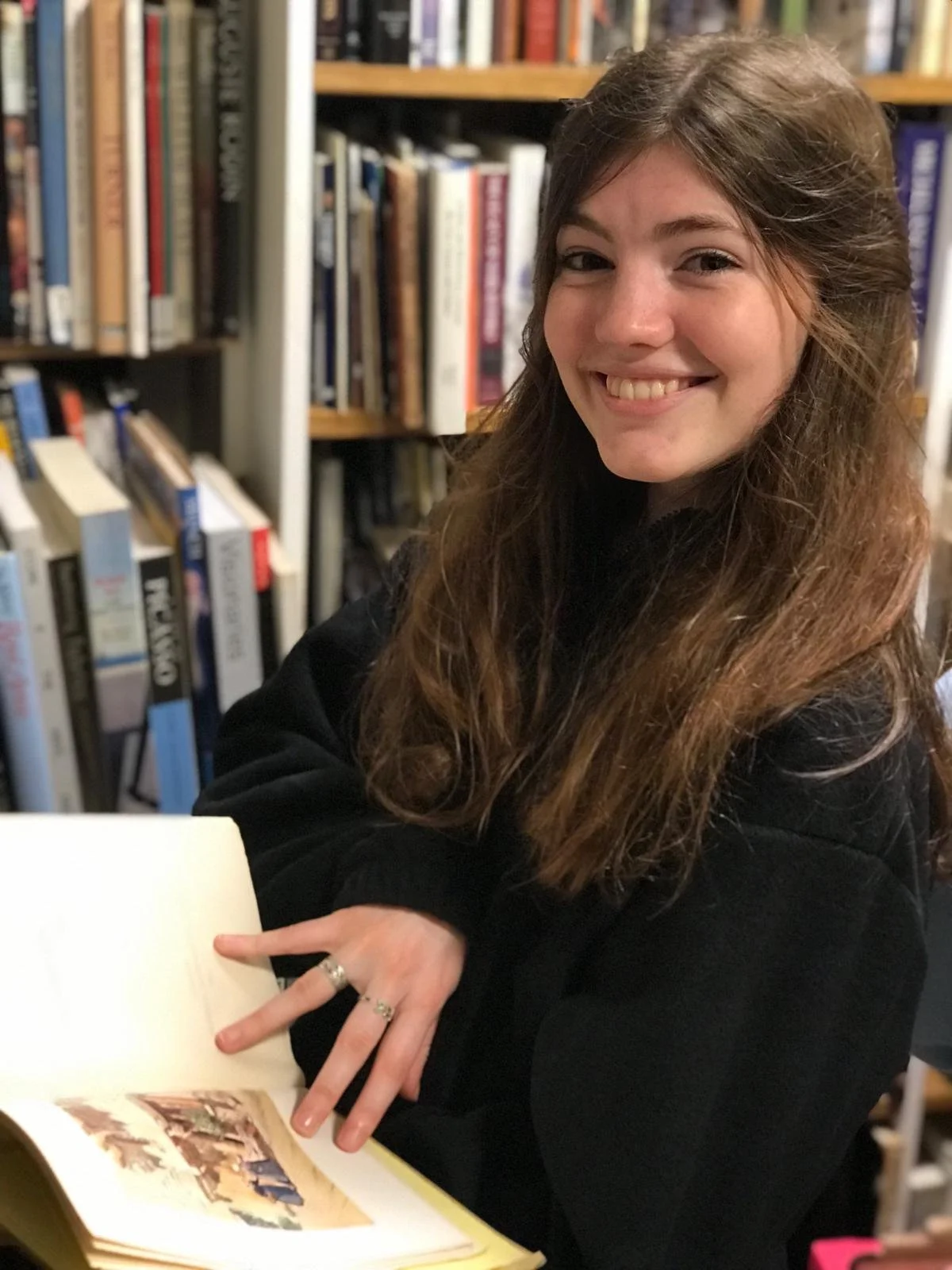
Abigail Shaw is a Somerset Writer. She holds a BA (Hons) in English and Creative Writing from Royal Holloway along with an MA in Creative Writing (Fiction). Her poetry has been published in The Alchemy Spoon, The Orbital, and Royal Holloway Poetry Society Zines. She has published two collections of short stories and is working on her first novel about girlhood in rural Somerset.